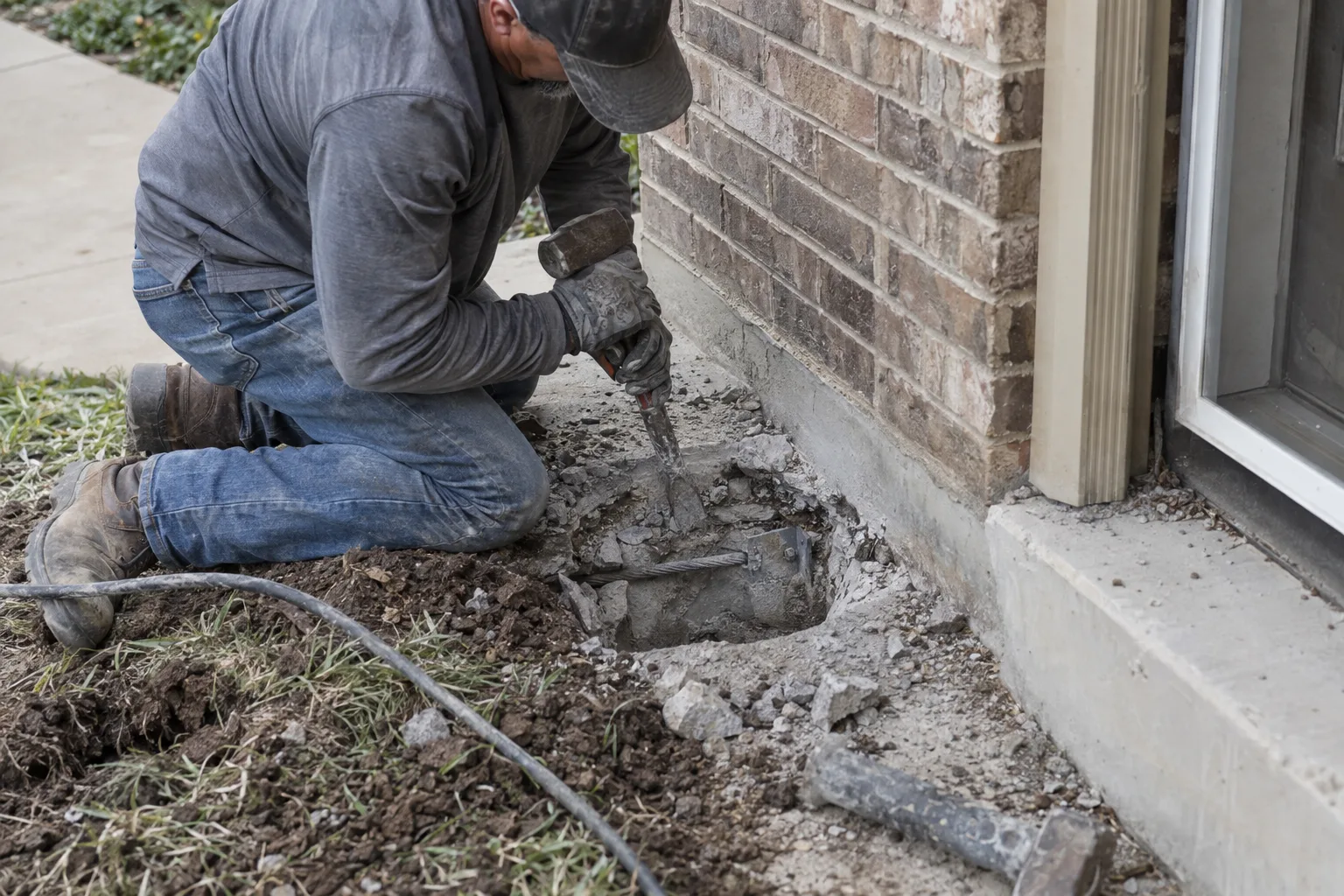
Receive a written repair scope before we touch a single cable.
What "Broken Post-Tension Cable" Means in Structural Terms
A broken post-tension cable has completely lost its stored tension - and that changes how your slab carries load.
Here's what most homeowners don't realize about that redistribution: the tension doesn't simply disappear. It shifts to neighboring cables and to the concrete itself. That's load redistribution - the process by which adjacent cables and the slab absorb the stress a broken cable can no longer handle.
One broken cable on a properly constructed slab is serious. It is not, in most cases, an immediate collapse risk. But it does create accelerated stress on the cables nearest to the failure. That's why the repair clock starts at diagnosis - not at crisis.
The inspection report you're holding documents a confirmed failure. The cable has completely severed - it is no longer contributing to the slab's structural performance. That's the technical definition of a broken post-tension cable.
What the report often doesn't explain: where exactly the break is, what caused it, and what repair looks like from start to finish. That's the gap we close.
Inspection-Report Season in DFW - Why These Findings Are So Common
Dallas-area inspection reports flag broken PT cables more often than almost anywhere else in the country - and the reason is the soil under your feet.
The DFW metroplex sits on Blackland Prairie, a belt of highly expansive Montmorillonite clay that runs through Dallas, Garland, Mesquite, and down through Waxahachie and Corsicana. This soil shrinks dramatically during dry summers and swells when rain returns. That cyclical movement - sometimes several inches of vertical shift across a single season - applies stress to PT slabs that engineers in other regions never account for.
Homes in University Park, Highland Park, inner Irving, and established Garland neighborhoods built in the 1980s and early 1990s are now entering a vulnerable window. PT cables installed during that era were well-made. But 30 to 40 years of DFW soil cycles, combined with any moisture that reached the cable sheathing, creates the conditions for corrosion-driven failure - a break caused by rust slowly reducing the cable's cross-section until it snaps.
The 2011 drought accelerated this process significantly across the Dallas area. Slabs that had minor sheathing damage before 2011 often saw faster corrosion in the years that followed. Many of those cables are showing up on inspection reports today.
If your report mentions a broken cable on a 1980s or 1990s Dallas-area home, that context explains why. It's not necessarily poor construction. It's decades of one of the most demanding soil environments in North America.
From Inspection Checkbox to Repair Plan - Closing the Information Gap
An inspection report tells you what's wrong. A repair scope tells you what happens next.
I've reviewed hundreds of home inspection reports that flag broken post-tension cables. The checkbox says "broken PT cable observed." Sometimes there's a photo of a slab edge with spalled concrete or a displaced pocket cover. Sometimes there's a note recommending further evaluation by a structural specialist.
What those reports almost never include: the cable's exact location within the slab grid, whether the break is at the anchor end or mid-span, whether adjacent cables show signs of corrosion stress, or what the repair will require in terms of concrete removal, re-anchoring, and pocket restoration.
That gap between the inspection checkbox and an actual repair plan is where most Dallas homeowners get stuck. They're holding a document that confirms something is wrong but doesn't tell them who to call, what to authorize, or whether the problem is at the edge of the slab - where access is straightforward - or under a finished floor, where it's more involved.
Here's how we close that gap. We start by reviewing whatever documentation you have. Then we walk the slab and locate the cable in question. We confirm the break and assess whether adjacent cables show tension loss or corrosion signs that the original inspector may not have been equipped to evaluate.
From that field assessment, we produce a written repair scope - not a verbal estimate, not a ballpark. A document that identifies the cable, describes the failure location, outlines the repair method, and specifies what the concrete work will look like. That scope is what you bring to a buyer's agent, a lender, or an insurance adjuster.
The inspection report opened the conversation. The repair scope is what closes it - with clarity instead of anxiety.
How to Know the Diagnosis Is Accurate Before You Spend Anything
You shouldn't have to take anyone's word for a broken cable - verification is part of our process.
A home inspection report is a visual observation document. Inspectors are licensed to identify conditions and recommend further evaluation. They are not post-tension specialists. That's not a criticism - it's the design of the system. What it means for you: the report is a starting point, not a final verdict.
Here's how we handle that. Before any repair work is authorized, we confirm the diagnosis independently. We locate the cable using the slab layout, identify the failure zone, and document our findings with photos and written notes. If a licensed Professional Engineer - an engineering assessment by a licensed PE who reviews structural significance - is warranted by the scope of the damage or required by your lender or local jurisdiction, we coordinate that step into the process.
A real estate transaction puts additional pressure on this. If you're a seller, you need the diagnosis confirmed before you can accurately disclose the condition and present a credible repair plan to buyers. If you're a buyer, you need independent verification before you can decide whether to proceed, negotiate, or request a repair credit.
We provide written confirmation of findings before we write a single line of repair authorization. You understand what you're dealing with before you decide anything.
The Repair Process for a Broken Cable - From Confirmation to Completion
Every broken post-tension cable repair follows a defined sequence - no guesswork, no shortcuts.
Here's what our repair standard looks like for a broken cable in a Dallas residential slab:
- Written scope first.You receive a repair scope document before any work begins. It identifies the cable, describes the failure, and specifies the repair method.
- Concrete removal is surgical, not broad.We expose only what's needed to access the break and perform the repair - not the entire slab edge.
- Anchor hardware is inspected.The dead end (fixed anchor) and live end (stressing anchor) are both evaluated. If the pocket cover is missing or damaged - a corrosion pathway - that gets addressed as part of the repair, not as a future concern.
- Repair method matched to failure type.A mid-span break has different repair requirements than an anchor-end failure. We match the method to the actual failure location.
- Re-grouting to PTI standards.Pocket covers are restored using materials and methods consistent with Post-Tensioning Institute DC80.3 - the industry specification for unbonded single-strand tendons.
- Concrete restoration is included.Wherever concrete is removed to access the cable, it is patched and finished. The repair zone is not left as exposed aggregate.
- Photo documentation throughout.Before, during, and after photos are part of every job file - available to you for insurance, real estate, or lender use.
What Gets Fixed, What Gets Documented, and What the Slab Looks Like After
When the repair is complete, the slab looks repaired - and you have paperwork that proves it was done correctly.
Diagnostics
We begin with a field assessment of the failure zone. The cable location is confirmed, and we review the surrounding slab edge for signs of corrosion-driven failure - rust staining, spalled concrete, missing or degraded pocket covers, or displaced anchor hardware. Any of these conditions may indicate that adjacent cables are experiencing similar stress.
Corrosion-driven failure - the most common failure mechanism in older DFW slabs - leaves recognizable signatures. Rust bleed at the pocket, concrete delamination at the slab edge, or a visible gap where a cable once held the pocket cover in compression. These aren't incidental. They inform the scope of work.
Implementation
Concrete is removed at the failure zone. For a slab-edge break, this typically means exposing the pocket and anchor assembly. For a mid-span break, access depends on what's above the slab - finished flooring, tile, or bare concrete each present different access requirements, and we walk you through those specifics in the written scope before any work begins.
The broken cable is addressed using the method appropriate to the failure type. Anchor hardware is inspected and replaced where deteriorated. The pocket is restored and covered. Concrete is patched and finished flush with the surrounding surface.
Here's something specific to Dallas construction that matters: many 1980s DFW slabs used pocket forming systems that left larger voids than current standards specify. When we restore those pockets, we use materials appropriate to the original void size - not a one-size approach. That detail matters for long-term moisture exclusion.
Post-Service Documentation
The completed repair is documented with a full photo record and a written summary of the work performed. The scope, method, materials, and completion status are recorded in writing. If an engineering assessment by a licensed PE is part of the process, that documentation is incorporated into the repair file.
The slab looks repaired - not patched, not marked. The concrete at the repair zone is restored to finished condition. What you're left with is a slab with a confirmed repair and paperwork that supports every downstream use: disclosure, appraisal, insurance, or simply your own records.
Serving Established Dallas Neighborhoods Where 1980s and 1990s Slabs Are Aging
We serve the Dallas neighborhoods where these inspection-report findings are most common.
Our service routing covers University Park, Highland Park, Garland, Mesquite, Irving, Carrollton, Richardson, Farmers Branch, DeSoto, Duncanville, Cedar Hill, and Balch Springs - the established Dallas-area communities where post-tension slabs from the 1980s and 1990s are now reaching the age where inspection-report findings become more frequent.
We also serve Addison, Rowlett, Sachse, Grand Prairie, and surrounding areas throughout the Dallas metro.
Get a Written Scope Before You Decide Anything
You read the report. Now get the repair scope.
A broken post-tension cable in a Dallas home is a solvable problem. The first step isn't the repair - it's the written scope that tells you exactly what repair involves, where the failure is, and what the slab looks like when the work is finished.
Email us at info@posttensioncablerepair.com with your inspection report or a description of what you've been told. We'll review it and respond with clear next steps - in writing, before any work is authorized.