# When Repair Isn't Enough - Full PT Cable Replacement in DFW
When a Repair Won't Hold - The Case for Full Cable Replacement
Post-tension cable replacement restores what a compromised repair cannot - full load-bearing capacity from anchor to anchor.
Repair works when the damage is localized. A mid-span nick, a single corroded section, a pocket that failed to seal - those are repair scenarios. But when the steel strand itself has deteriorated along its full length, or when the anchor hardware has mechanically failed, a patch does not bring the cable back to its designed specification. Full post-tension cable replacement in Dallas-Fort Worth means removing the deteriorated strand entirely, installing new ASTM A416-grade steel - the standard specification for low-relaxation strand used in PT systems - tensioning to the engineer's target load, and sealing the pocket correctly. The result is a cable performing as it was originally designed to perform.
Aging DFW Slabs and the Corrosion Timeline Nobody Warned You About
Dallas-Fort Worth's oldest PT housing stock is now entering the window where corrosion propagation becomes a full-strand problem.
Homes built heavily between 1975 and 1995 - concentrated in Near East Dallas, Oak Cliff, the Wedgwood neighborhood in Fort Worth, and older Garland and Irving corridors - represent some of the highest-density replacement-eligible PT systems in the DFW metro. All of these neighborhoods fall within our direct service range.
Here's what most homeowners don't realize about aging PT cables in this climate. The plastic sheathing that protects each strand from moisture begins degrading after two to three decades, especially under DFW's cycle of extreme heat and drought. Once the sheathing cracks, moisture reaches the steel. Corrosion propagation - the spread of oxidation along the cable's full length - can advance silently for years before showing up at the slab edge. By the time you see rust staining or spalling concrete at the pocket, the damage has often traveled well beyond what mid-span repair can address.
Cable service life - the expected functional lifespan of a PT cable - runs 30 to 50 years under ideal conditions. DFW's Blackland Prairie clay shortens that window. Cyclical soil movement during drought years places tensile stress on strands that were never engineered for this soil's specific behavior.
From the field
From Inspection Finding to Replacement Decision - How the Scope Gets Defined
Every replacement decision starts the same way: a systematic look at what the cable can and cannot still do.
The call came from a homeowner in Garland. Her inspector had flagged two cables during a pre-sale assessment - both showing rust staining at the pocket and what the report described as "compromised anchor hardware at the live end." The inspector had recommended an engineer review before closing. She called us before calling the engineer.
I walked the slab edge first. Both pockets were open - the original grout had failed completely, and moisture had been entering for years. One cable showed surface rust at the exposed tail. The other was worse: the wedge-and-barrel anchor hardware had corroded to the point where it had partially separated from the bearing plate. That is anchor-end failure - the condition where the hardware that holds the cable's tension has degraded beyond repair. You cannot fix that with a mid-span repair kit. You need full strand removal and replacement.
We documented both conditions with photographs before touching anything. The homeowner needed that record for the buyer, for the lender, and for her own disclosure file. I explained that one cable was a repair candidate - the corrosion was limited to the pocket zone - and one was not. We replaced the damaged strand: extracted the failed cable, threaded new ASTM A416-grade steel through the existing duct, seated new anchor hardware at both ends, tensioned to specification, and regrouted both pockets. The repair-eligible cable was handled separately with mid-span technique.
She closed on the house. The buyer's lender accepted the documentation. That's the outcome proper scope definition produces.
Replacement Is the Right Call When These Conditions Are Present
Full cable replacement is the appropriate response to specific, diagnosable conditions - not a default recommendation.
This business does not recommend replacement when repair is viable. The assessment process identifies the difference clearly. These are the conditions that make replacement the right answer:
| Repair-Eligible Conditions | Replacement-Eligible Conditions |
|---|---|
| Localized mid-span damage | Corrosion propagation along the full strand length |
| Single corroded section with intact anchor hardware | Anchor-end failure at the live or dead end |
| Pocket failure without strand deterioration | Sheathing compromised across most of the cable's run |
| Cable intact, pocket seal failed | Cable past documented cable service life threshold |
When anchor-end failure is confirmed, partial repair does not restore the cable's ability to hold tension. The anchor hardware is what keeps the strand loaded. If that system has failed, the cable is not performing its structural function regardless of what the mid-span looks like. Full strand removal is the only path to restoring load-bearing capacity restoration - returning the slab's tensile reinforcement to its original engineering specification.
Full Replacement Scope - Removal, New Strand, Anchoring, and Pocket Seal
Every replacement follows the same standard of work - material, method, and documentation do not vary by job size.
- Strand material:ASTM A416 low-relaxation steel - the same grade specification used in original installation
- Anchor hardware:New wedge-and-barrel components seated at both live and dead ends
- Tensioning:Applied to the engineer's specified load - verified with calibrated equipment
- Pocket regrouting:Non-shrink grout sealed at both ends using correct cover depth - pocket regrouting is not cosmetic, it is the moisture barrier for the new cable
- Documentation:Written record of cable location, material specs, tension readings, and post-installation condition - provided to the homeowner at job close
- Concrete restoration:Repair zone is returned to finished condition - no open cuts, no exposed hardware
Three coats of grout protection. Not two. Moisture getting back into a new cable defeats the entire investment.
The Replacement Process From Slab Opening to Finished Restoration
Full post-tension cable replacement follows a defined sequence - every step is load-bearing, not optional.
Diagnostics
Slab edge inspection confirms pocket condition and anchor hardware integrity. If the cable's condition is not fully visible from the pocket, controlled cutting is used to expose the strand at the failure zone. We photograph the condition before proceeding. The homeowner receives a written scope document before any slab work begins.
Implementation
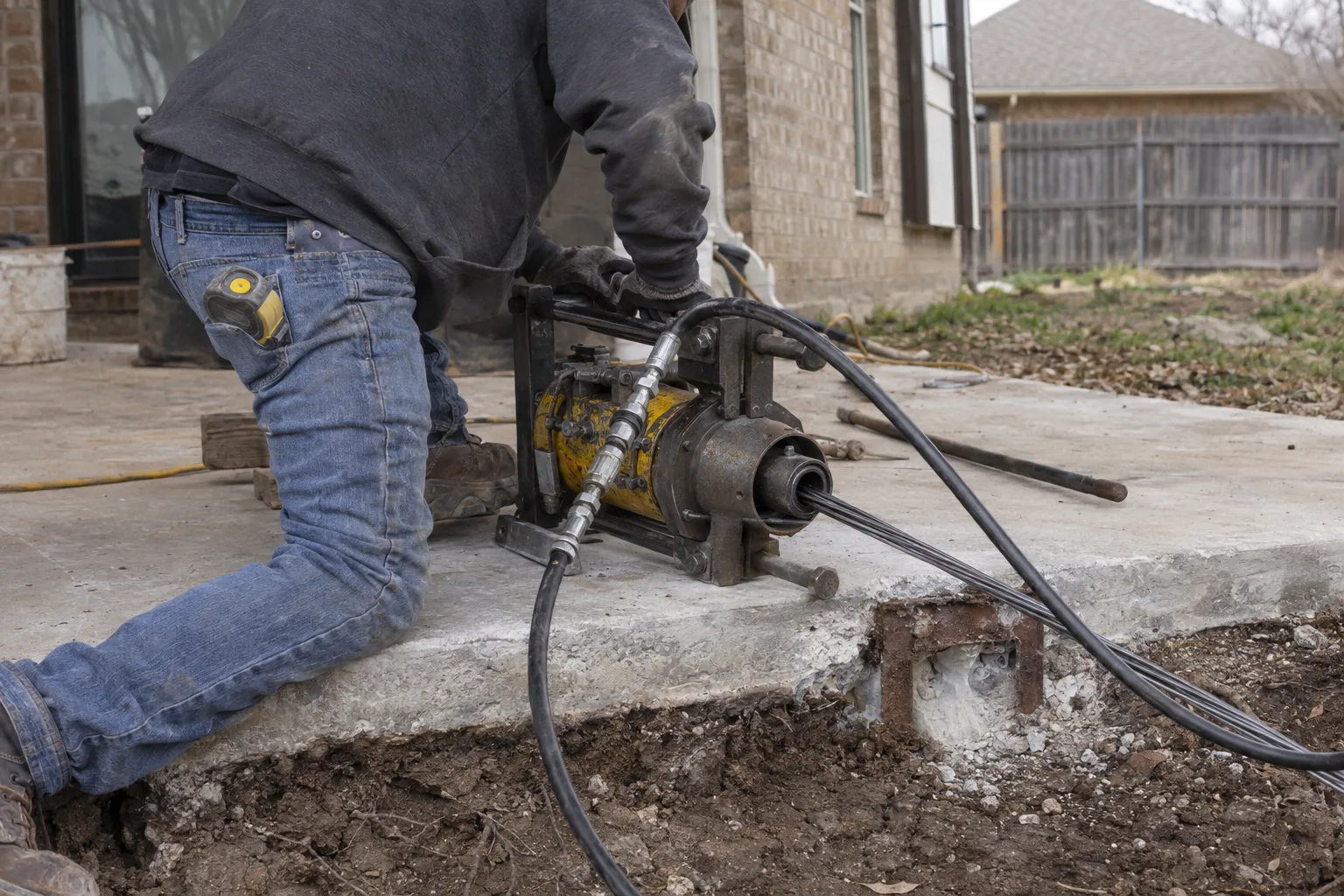
Controlled concrete cutting opens access at both ends of the cable run. The failed strand is extracted through its duct path - full strand removal requires precise technique to avoid damaging adjacent cables or the duct itself. New ASTM A416 strand is threaded through the existing duct. New anchor hardware is seated at the stressing end. The hydraulic jack applies tension to the engineer's specified load. Tension readings are recorded before and after seating. The tail is cut and the pocket is prepared for final grouting.
Post-Service Testing & Restoration
Pocket regrouting is completed using non-shrink, moisture-resistant grout to full cover depth. No pocket is left open. The concrete restoration is completed at the work zone - the slab edge is returned to finished condition. The homeowner receives the written documentation package: cable location, material specification, tension readings, grout type, and post-installation photos. That package is what a lender, insurance adjuster, or future buyer will ask for.
Replacement Services for 1970s-1990s DFW Housing Stock
We serve the Dallas-Fort Worth communities where aging PT slabs are most concentrated.
Dallas, Irving, Garland, Mesquite, Grand Prairie, Carrollton, Richardson, Farmers Branch, Duncanville, DeSoto, Cedar Hill, Balch Springs, Rowlett, Addison, University Park, Highland Park, Fort Worth, Arlington, Plano, Frisco, McKinney, Denton, Allen, Lewisville, Flower Mound, Euless, Bedford, Hurst, Grapevine, Southlake, Colleyville, Mansfield, Rockwall, Sachse, Wylie, Lancaster, Waxahachie, Ennis, Corsicana, Waco, and surrounding communities throughout the DFW metroplex.
Find Out Whether Repair or Replacement Fits Your Slab
The difference between repair and replacement starts with an honest look at what your cable can still do.
If you've received an inspection report flagging cable condition, anchor hardware, or pocket damage - or if your slab is approaching the end of its cable service life - the right next step is a direct assessment. Contact Post Tension Cable Repair at info@posttensioncablerepair.com. Describe what your inspector found. We'll review it, explain what the findings mean, and give you a clear picture of whether repair or full post-tension cable replacement in Dallas-Fort Worth is the right path for your slab.