Three Situations That Make a PT Slab Inspection Worth Doing Now
A PT slab inspection gives you a documented answer when a verbal guess won't cut it.
There are three moments when homeowners reach out for a post-tension cable inspection. The first is before a real estate transaction - either listing a home or going under contract on one. The second is after a renovation, plumbing repair, or any project that opened or penetrated the slab. The third is simply time: a home in the 20-to-40-year range where nobody has ever looked at the cable system closely.
None of these situations require an emergency. That's worth saying clearly. An inspection isn't about panic. It's about knowing exactly what you have, in writing, so you can make an informed decision.
Here's what most homeowners don't realize about PT slab inspections: a checkbox on a standard home inspection report and a true condition assessment - a written evaluation of pocket integrity, anchor hardware, slab-edge condition, and cable placement - are completely different documents. One gives you a flag. The other gives you answers.
Why DFW Real Estate Transactions Keep Running Into PT Cable Surprises
DFW's fast-moving market doesn't wait for foundation questions to resolve themselves.
The real estate corridors in Plano, Frisco, and McKinney move quickly. So do the transaction-active neighborhoods in Richardson, Garland, and Mesquite. When an inspector flags a potential PT cable concern, everyone freezes. The buyer doesn't know how serious it is. The seller has never heard of the issue. The lender gets nervous.
That freeze costs time - and in a DFW transaction, time often costs the deal.
The underlying cause is straightforward. Dallas-Fort Worth sits on Blackland Prairie clay, one of the most expansive soil types in North America. That clay shrinks during the long, hot summers and swells when rain returns. That cycle puts continuous mechanical stress on PT slabs that homeowners in other parts of the country never deal with. Homes built from the 1970s through the 1990s - a massive portion of DFW's existing housing stock - now have cable systems that are 30 to 50 years old.
A pre-sale PT inspection, defined here as a formal condition assessment before a home goes to market or under contract, creates documentation before the flag ever appears. That's a different position entirely.
What an Inspector Flags Versus What a Condition Assessment Actually Covers
A general home inspection and a PT condition assessment are not the same service.
I've looked at hundreds of homes across the DFW metro where the original inspection report said something like "evidence of post-tension cable issue - recommend further evaluation." That phrase sends everyone scrambling. What it usually means is that an inspector saw open grout pockets along the slab edge, some surface spalling near the foundation perimeter, or a small concrete pop-out near a cable tail.
Those findings are real. But they're not diagnoses.
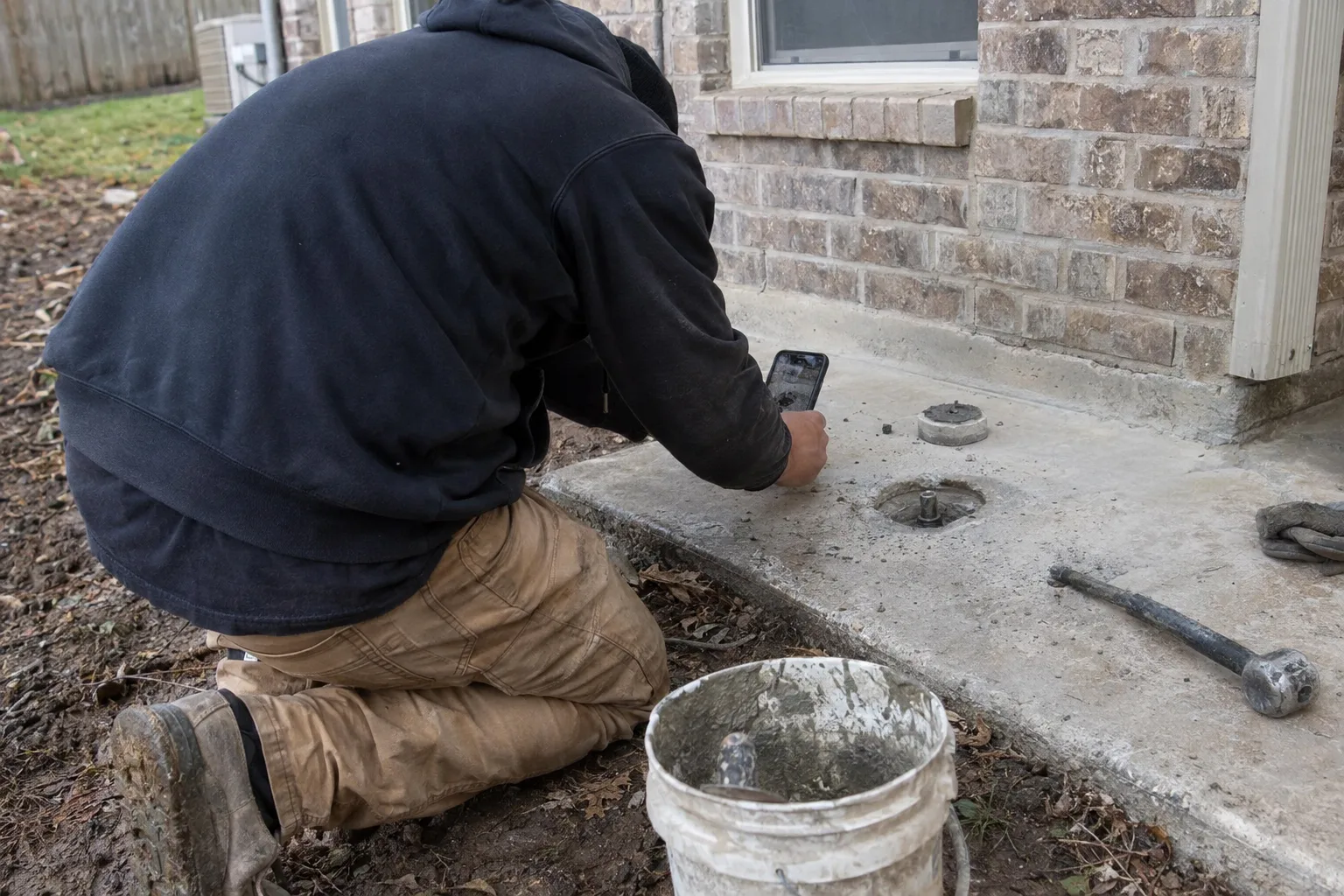
What a thorough condition assessment actually does is different. We start at the slab perimeter. Every visible pocket - the small rectangular recesses where anchor hardware sits - gets examined. Open, improperly filled, or deteriorated pockets are documented with photos. That matters because exposed anchor hardware is a corrosion entry point, not just a cosmetic issue.
From there, we look at the slab-edge condition more broadly. Spalled concrete near a cable tail, concrete that's cracked outward from an anchor zone, or any area where the slab edge has ejected material - these are specific indicators with specific meanings.
Where GPR scanning is applicable, we can confirm cable positions and identify subsurface anomalies without cutting or coring the slab. GPR, or Ground Penetrating Radar, is a non-destructive scanning technology that locates cable locations and reveals what's happening beneath the surface.
Here's the critical piece: everything gets written down. Not summarized verbally at the door. Not emailed as a quick note. A formal condition assessment report - documenting observed findings, their locations, their severity, and a plain-language interpretation - is what comes out of this process. That document is what buyers, lenders, and title companies actually need.
A home in Garland with a 1988-era PT slab and three open pockets and a home in Frisco with a 2019 slab and a fresh plumbing penetration need different answers. The assessment makes that distinction clearly.
A Written Report Protects Sellers, Satisfies Lenders, and Calms Buyers
Documentation is what turns a slab question into a resolved item.
Sellers in Texas operate under mandatory disclosure requirements. Texas Property Code Section 5.008 requires disclosure of known material defects - including foundation and structural conditions. A condition assessment report gives sellers something precise to disclose rather than a vague concern. That's a legally and practically meaningful difference.
For buyers, a lender flag - the notation a lender or appraiser makes when a property shows signs of structural or foundation distress - can stall or kill a loan. A written report from a PT specialist that documents the slab's current condition and provides context for what an inspector found is exactly what loan processors ask for in those situations.
For the homeowner who isn't buying or selling, the value is simpler. You have a baseline. If anything changes in two or five years, you have a dated document showing what the slab looked like before. That comparison matters when you're making decisions about repair, filing an insurance claim, or evaluating what a future contractor tells you.
Three coats. Not two. That standard of documentation is how this team operates.
What a Thorough PT Inspection Covers - From Pocket to GPR Scan
Every component of the cable system gets checked, documented, and explained.
The scope of a complete post-tension slab inspection includes:
- Slab-edge perimeter walk:Every accessible linear foot of the foundation edge, documenting pocket locations, pocket condition, and any visible anchor hardware exposure
- Grout pocket and anchor hardware assessment:Pocket cover condition, fill material integrity, signs of corrosion staining, or hardware that has pulled or shifted
- Concrete condition review:Spalling, cracking patterns, pop-outs, and any evidence of cable-related slab movement at the perimeter and interior where accessible
- GPR scanning (where applicable):Non-invasive confirmation of cable layout, spacing, and position - particularly useful after plumbing or renovation work near the slab
- Post-renovation verification:When slab penetrations have occurred, a targeted assessment of the affected zones to confirm no cables were inadvertently cut or damaged
- Written Condition Assessment Report:Plain-language findings organized by location, severity, and recommended next steps - suitable for lenders, buyers, insurance carriers, and title companies
No verbal summaries handed off at the curb. The written report is part of the service, not an add-on.
From Scheduling to Delivered Report - What the Inspection Day Looks Like
Booking a PT slab inspection through this team is straightforward from first contact to final report.
Diagnostics
The process starts with a brief intake conversation - property address, reason for inspection, and any existing reports or concerns the homeowner or buyer already has. That context shapes what we focus on during the site visit. A pre-sale inspection for a 1992-build in Mesquite has a different starting point than a post-renovation check on a 2016 build in Allen.
On-site, the perimeter walk happens first. This is where the visible condition of every grout pocket and anchor zone gets recorded. For standard residential slabs, most of the diagnostic information lives at the slab edge. That's where the system shows its age first.
Implementation
Interior and exterior slab-surface conditions are documented next. Where GPR scanning is included, the scan runs systematically across the affected zones - not spot-checked at one or two points. The goal is a complete picture of cable layout in the areas that matter for the specific inspection purpose.
Findings are photographed with location markers so the written report ties descriptions to specific places on the slab. A finding at the northeast corner means something different from the same finding at the rear garage wall.
Post-Service Testing
The completed Condition Assessment Report gets reviewed against the site photos before delivery. Every finding is categorized: observed but not currently distressed, showing signs of age-related wear, or indicating active concern that warrants follow-up.
The report includes a plain-language summary at the front - written for buyers, sellers, and lenders who aren't structural engineers - followed by the detailed findings. Delivery timing is confirmed at scheduling. The report is a document you can hand to your real estate agent, your lender, or your attorney.
If findings indicate a repair is needed, the report notes that clearly and provides a path to the next step - without pressure, and with options explained.
Inspection Coverage From Plano and Frisco to Richardson, Garland, and Mesquite
This team serves the full DFW inspection footprint - no subcontracting, no coverage gaps.
We cover pre-sale and post-renovation PT inspections across Dallas, Plano, Frisco, McKinney, Allen, Richardson, Garland, Mesquite, Irving, Carrollton, and Farmers Branch. Service extends to Fort Worth, Arlington, Denton, Lewisville, Flower Mound, Grapevine, and Southlake. Outlying areas including Rockwall, Wylie, Rowlett, Waxahachie, and Weatherford are within our service footprint as well.
Schedule Your Condition Assessment Before the Next Showing
Get a written report on your slab's condition - before a flag becomes a problem.
If a home is going to market, under contract, or coming off a renovation, a PT slab inspection now creates documentation that protects the deal. Email us at info@posttensioncablerepair.com with your property address and what's driving the inspection. We'll confirm scheduling and walk you through exactly what to expect before the site visit.