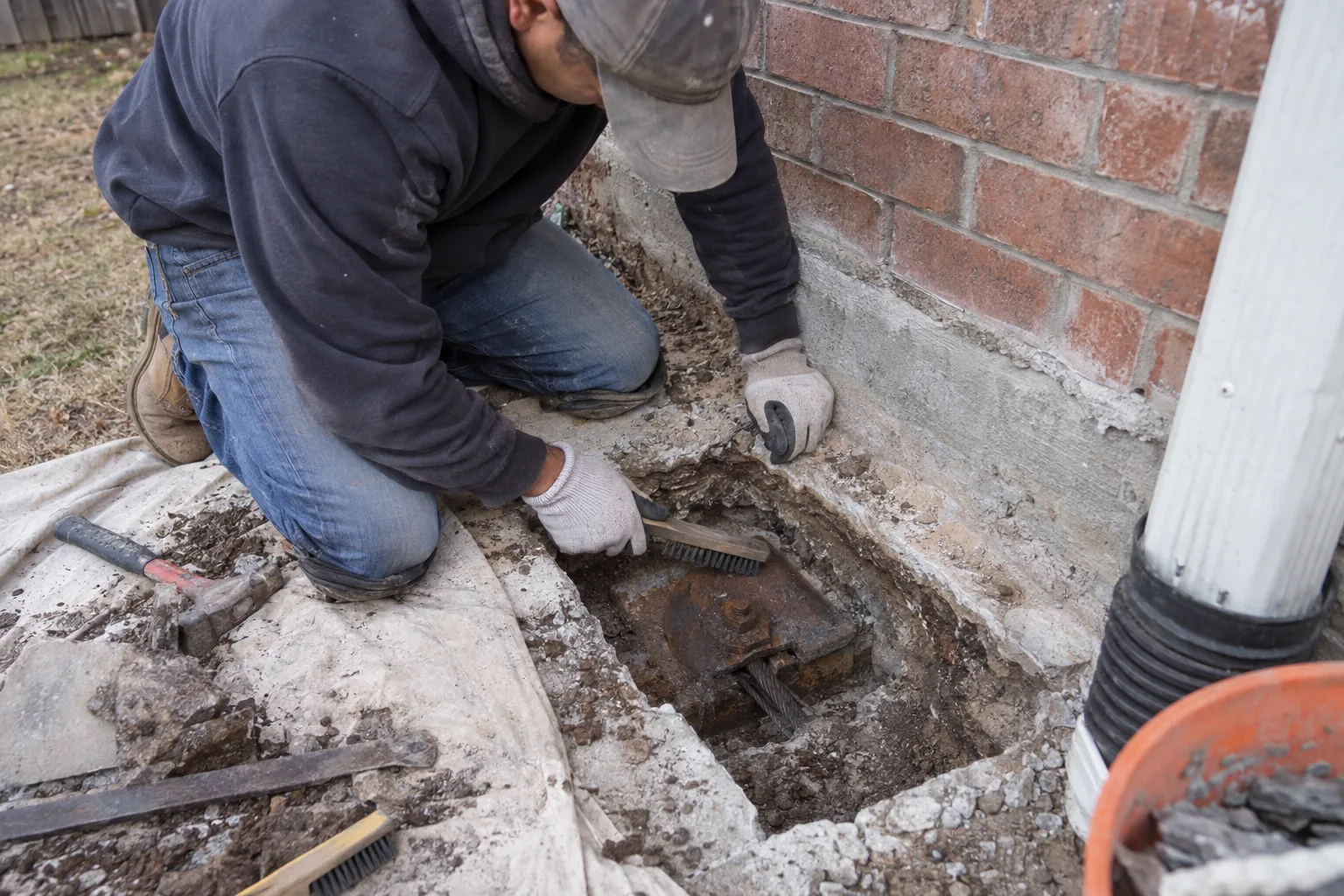
What Post-Tension Pockets Are and Why Open Ones Create a Problem
Open post-tension pockets expose the steel anchor hardware that holds your cables under tension.
A post-tension pocket - the recessed opening at the edge of a post-tension slab where the cable's anchor hardware is seated - is not decorative. It's a protective cavity. At the time of construction, each pocket gets filled with pocket grout - a non-shrink cementitious material that seals the anchor hardware from the outside environment.
That seal matters a lot.
The anchor hardware inside is a wedge-and-barrel mechanical assembly. It grips the cable strand and holds it under load - permanently. When the pocket grout cracks, crumbles, or was never properly installed, moisture reaches that hardware directly. Moisture plus steel under tension is a corrosion pathway - any gap that allows direct moisture contact with the steel anchor hardware or cable strand - and once that pathway opens, the deterioration is slow, invisible, and cumulative.
Here's what most homeowners don't realize about their slab edge: a single open pocket isn't a cosmetic issue. It's the first stage of a process that ends at the cable.
Post tension pocket repair in Dallas is not an emergency call in most cases. But it is work that gets more expensive the longer it waits.
Freeze-Thaw Cycles and DFW Summers - How Moisture Gets Into Your Pockets
DFW's climate is unusually hard on pocket grout - and most homeowners never know it.
The Dallas-Fort Worth area doesn't get the sustained freeze-thaw cycles that destroy concrete in northern climates. But it does get something equally damaging: sharp temperature swings combined with high summer humidity. July and August bring 95-degree days with dew points above 70. Then February arrives with hard freezes - the February 2021 event being the most recent example - that push moisture that absorbed into open pockets straight into expansion cycles.
That repeated absorption and freeze damages original pocket grout from the inside out.
Meanwhile, DFW's Blackland Prairie clay - the expansive montmorillonite soil that runs under most of the metro - shifts with every drought and rainfall cycle. That movement creates micro-gaps along slab edges where grout has already started to separate. Neighborhoods in Irving, Grand Prairie, and older Garland subdivisions show this pattern consistently on homes built in the 1980s and 1990s. Post tension anchor repair DFW calls from these areas often start with a homeowner who noticed rust staining on their foundation edge - the first visible sign that the anchor hardware inside has already begun oxidizing.
Walking the Slab Edge - What a Pocket Inspection Finds on Older Dallas Homes
An experienced eye finds more along a slab edge than most homeowners ever noticed was there.
When our team walks a slab edge on an older Dallas home, the first thing we do is move slowly and low. Pockets sit at or near ground level. Overgrown landscaping, mulch, and sod frequently bury the lower half of the slab perimeter entirely. We clear that back before we evaluate anything.
What we find varies by era. On homes built before the mid-1990s, the original pocket grout is often chalky - it decomposes rather than cracks, leaving a powdery residue around the pocket opening. On mid-1990s through early 2000s construction, we see more shrinkage cracking in the fill. The pocket looks intact from a distance, but probe it and pieces release easily.
The dead end - the fixed, non-stressing end of a post-tension cable anchored passively in the slab - gets less attention than the live end because it's less visible. But dead-end pockets fail too. When we find rust staining trailing down from a pocket, we probe both ends of that cable run before drawing any conclusions.
Here's the finding that surprises homeowners most: a pocket can appear full while still being fully open to moisture from behind. Grout shrinks as it cures. If the original fill wasn't a true non-shrink formulation, it pulled away from the pocket walls years ago. The front looks sealed. The back is an open channel.
That's why PT pocket grouting in Dallas TX has to start with probing and cleaning - not simply applying new material over old.
Pocket Repair Done Correctly Stops Corrosion Before It Reaches the Cable
A properly restored pocket is the simplest way to extend the service life of the cable behind it.
Some customers come to us with a quote in hand that shows pocket fill as a line item. The quote doesn't mention cleaning. It doesn't mention corrosion inhibitor. It just shows a material and a price.
Here's how we handle it differently: we never apply new grout over a pocket until we know the condition of the anchor hardware inside.
If the anchor head shows early oxidation - surface rust without pitting - we apply a corrosion inhibitor to the hardware before the pocket is resealed. The inhibitor penetrates the oxide layer and arrests further progression. If we find the anchor hardware has deteriorated beyond surface rust, we document that and recommend the appropriate next step, which may move into post tension anchor head repair territory.
The goal of pocket restoration is not to cover the problem. It's to re-establish the original moisture barrier and do it in a condition that actually protects what's behind it. That's the standard we apply on every pocket, whether the slab is in Rockwall or in the medical district of Dallas.
Clean, Assess, Inhibit, Regrout - The Full Pocket Restoration Sequence
Every pocket on this team gets the same four-step sequence - no shortcuts.
What we do on every pocket repair:
- Remove all failed grout materialincluding any fill that probes soft, cracks under light pressure, or has separated from the pocket walls
- Clean the pocket cavity and anchor hardwareusing wire brushing and compressed air to remove debris, corrosion products, and deteriorated cementitious material
- Assess anchor hardware conditionand document with photographs - surface rust, active corrosion, wedge condition, and cable tail integrity are all noted
- Apply corrosion inhibitorto any anchor hardware showing oxidation before pocket fill is placed
- Fill with non-shrink cementitious groutmixed to proper consistency, consolidated into the pocket fully, and finished flush with the slab face
- Photograph the completed repairso the homeowner has a dated before-and-after record for insurance, resale, or future inspection reference
Open post tension pocket repair in Dallas that skips the assessment step is not pocket repair. It's cosmetic patching. The difference matters when the next inspector walks that slab edge.
Pocket by Pocket - How Each Repair Gets Completed and Photographed
The process is methodical - one pocket at a time, with documentation at each step.
Diagnostics
We start at one corner of the slab and walk the full perimeter. Every pocket is located, numbered, and visually assessed. We note which pockets are open, which are cracked, which appear intact but test soft, and which have visible rust staining below them. This inventory becomes the work order.
Implementation
Each pocket is worked individually. Remove. Clean. Assess. Inhibit if needed. Fill. Finish. We don't batch-fill pockets from a single mix without working each one completely before moving to the next. Pocket grout has a working time - rushing the sequence compromises consolidation.
For pockets where we find the anchor hardware has advanced corrosion or structural concern, we stop, document, and walk the homeowner through what we found before proceeding. Post tension dead end repair or live end anchor replacement, if needed, gets discussed openly - not presented at the end of the job as a surprise.
Post-Service Documentation
Every completed pocket receives a photograph showing the finished repair. The full job set - before images, hardware condition notes, and after images - is delivered to the homeowner digitally. That record is exactly what a future home inspector, lender, or buyer wants to see when they ask about the slab edge.
Pocket and Anchor Repair Across Irving, Grand Prairie, Mansfield, Rockwall, and Beyond
We serve the full DFW footprint for post tension anchor repair - no subcontractors, no routing.
Our team reaches pocket and anchor calls across the DFW metro without routing through a third party. That includes established neighborhoods in Irving, Grand Prairie, Carrollton, and Garland, as well as growing corridors in Mansfield, Rockwall, Wylie, and Sachse. We also serve Denton, Lewisville, Flower Mound, and Southlake to the north, and extend south through Waxahachie and Ennis.
Let Us Walk Your Slab Edge and Show You What We Find
A slab edge walkthrough is the fastest way to know exactly what you're dealing with.
If you've noticed rectangular openings, rust staining, or crumbling fill along your foundation edge - or if an inspector flagged your post-tension pockets - contact us at info@posttensioncablerepair.com. We'll assess every pocket on the perimeter, document what we find, and explain your options before any work begins. No guessing. No surprises.