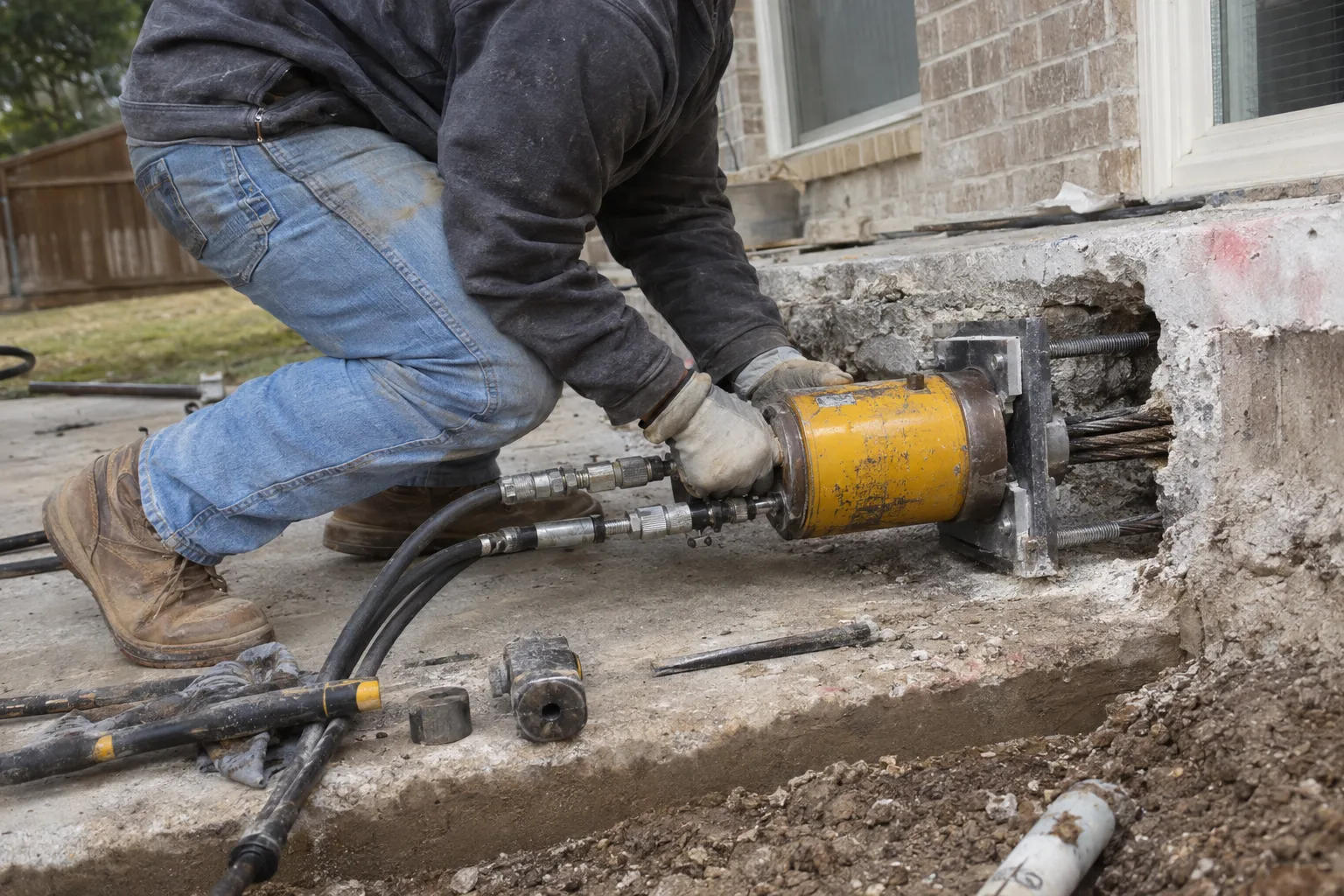
Target tension values measured, recorded, and handed to you in writing.
Cable Tension Loss - What It Is and Why Your Slab Feels Off Without Drama
A post-tension cable can stop doing its job without snapping, corroding, or showing any visible damage.
Here is what tension loss actually means. When a PT cable is first installed, a hydraulic jack pulls it to a precise force. That force compresses the concrete and holds it together under load. Over years, the high-strength steel naturally relaxes - a known property called steel relaxation, where the strand sheds a small percentage of its initial stress. Anchor wedges can also seat incompletely during original installation, locking in a slightly lower force than intended from day one.
The concrete itself changes too. Long-term creep - slow deformation under sustained load - absorbs a portion of the cable's clamping energy. None of this is catastrophic on its own. But in a DFW slab moving with expansive clay soil season after season, even a modest tension shortfall changes how the slab performs.
The result is differential slab deflection - uneven vertical movement across the slab surface when cable tension is no longer sufficient to hold the designed configuration. You feel it before you see it. Post-tension cable re-stressing - applying a fresh, measured tensile force to restore the cable to its design specification - is the fix.
Seasonal Soil Movement in DFW and Its Quiet Effect on Cable Tension
DFW soil stresses post-tension slabs more aggressively than most regions in the country.
The Blackland Prairie clay beneath Dallas, Plano, Denton, and most of the metro shrinks hard during dry summers and rebounds sharply when rains return. That cyclical movement - repeated over fifteen, twenty, thirty years - does something that engineers account for in design but that original installation can't fully offset: it works the cable system.
Each shrink-and-swell cycle applies load to the slab in ways the original tensioning moment never captured. A cable anchored at exactly the right force in 1988 has absorbed decades of that cycling. What seemed like healthy relaxation tolerance in year one may be a meaningful deficit by year twenty-five.
Here's what most homeowners don't realize about DFW slabs specifically: the February 2021 freeze event followed by rapid soil rebound created conditions where tension shortfalls in older cables showed up as new symptoms almost overnight. Slabs that had been stable for years suddenly showed hairline cracks along interior partition walls or minor floor elevation changes - not because anything broke, but because existing tension deficits were exposed by unusually aggressive soil movement.
That pattern repeats along the I-30 corridor through East Dallas and Mesquite - neighborhoods with 1980s and 1990s slab stock - with every significant drought-to-rain weather cycle. Re-tensioning post-tension cable systems in these areas is not unusual. It is a legitimate maintenance service with decades of precedent in the PTI standards.
Doors That Stick, Floors That Drift - Tracing Subtle Symptoms Back to the Cable
The symptoms of tension loss rarely announce themselves - they accumulate.
I want to walk through what this actually looks like in the field, because the gap between what homeowners experience and what they know to call it is real.
A call came in from a homeowner in Richardson - a 1994 single-story on a standard unbonded single-strand PT slab. The complaint was simple: a hallway door that had been binding for about a year, a hairline crack running diagonally from the corner of a bedroom window frame, and floors in the back half of the house that felt "soft" when walking across them. No loud snap. No visible damage at the slab edge. The homeowner had already had a foundation inspection that came back without pier recommendations.
Here is what the foundation inspector likely missed: they were looking for settlement patterns consistent with soil shrinkage and pier-addressable movement. They were not specifically evaluating cable tension. Those are different assessments.
When we evaluated the slab, the symptoms pointed toward differential slab deflection - the kind driven by insufficient cable tension across the rear third of the structure. The cables had not broken. The anchors were intact. But the applied force, measured against PTI DC80.3 reference values for unbonded single-strand tendons, was running below the lower boundary for the original design load.
Re-stressing two cables in the rear zone brought measurable results. The deflection across that section reduced within weeks as the slab settled into its restored tension state. The door still needed a minor adjustment - PT cable re-stressing does not undo years of frame shift overnight - but the underlying cause was addressed. That is the distinction this service makes.
Re-Stressing Restores What the Slab Was Designed to Do
Re-stressing is not a workaround - it is exactly what the design anticipated.
A common question homeowners ask: does re-stressing actually work, or is it just delaying a full repair?
The answer depends entirely on the condition of the cable. If the strand itself is intact - no corrosion, no physical damage, no anchor failure - then the cable still has structural capacity. It just is not using all of it. Re-stressing recovers that capacity. This is not improvisation. PTI DC80.3, the governing specification for the unbonded single-strand tendon system used across most DFW residential construction, explicitly addresses re-stressing as a valid intervention when tension loss is diagnosed.
Where re-stressing is not the answer: a cable with active corrosion, a failed anchor head, or strand damage needs repair or replacement - not additional force applied to a compromised component. Part of our process is confirming which situation you are actually in before anything is applied to the cable.
PTI DC80.3 Standards and How We Apply Them to Every Re-Stressing Job
Every re-stressing operation follows documented standards - not estimates, not approximations.
Here is how we approach the work:
- Target force is specific.We reference PTI DC80.3 for unbonded single-strand tendons. Where original slab drawings are available, design values are used directly. Where they are not, PTI reference values for the dominant residential strand sizes in DFW apply.
- Low-relaxation strand behavior is factored in.Modern installations use low-relaxation strand per ASTM A416, which sheds minimal tension over time. Older DFW slabs may have stress-relieved strand with higher relaxation characteristics. Those are treated differently.
- Hydraulic stressing jack calibration is not optional.The jack used to apply force must be calibrated to deliver accurate values. An uncalibrated jack produces numbers that look right on paper and mean nothing structurally.
- Re-stressing differs from repair and replacement.Re-stressing: cable intact, tension deficient. Repair: cable physically damaged, strand restored. Replacement: cable beyond service life or structurally unrecoverable. Each condition calls for a different response.
- Documentation is a deliverable.Every re-stressing job produces a written record: cable location, target value, achieved value, date. That record is yours.
The Re-Stressing Procedure - Jack Placement, Force Application, and Documentation
The re-stressing process follows a fixed sequence - nothing is improvised on-site.
Diagnostics
First, the slab is evaluated for symptoms consistent with tension loss: differential slab deflection patterns, crack geometry, door and window frame alignment, and floor elevation variance. We confirm that the cable is intact before any stressing operation begins. A damaged or corroded cable does not get re-stressed - it gets repaired or replaced. Attempting to apply tensile force to a compromised strand can cause failure rather than correction.
Where cable condition is uncertain, additional assessment is performed before the jack touches anything.
Implementation
The live end pocket - the access point where the cable tail is exposed at the slab edge - is opened. The hydraulic stressing jack is attached to the cable tail. Force is applied incrementally toward the target value derived from PTI DC80.3 or original design documentation.
Applied force is verified against the jack's calibrated gauge reading. Elongation of the cable is measured simultaneously and cross-checked against expected values. If the gauge reading and elongation measurement are consistent, the force is locked. If they diverge, something else is happening and the process stops for further evaluation.
After tensioning, the cable tail is trimmed, the pocket is regrouted with appropriate material, and the edge is restored.
Post-Service Testing and Documentation
Applied tension values are recorded for each cable. The homeowner receives a written re-stressing documentation report: cable locations, target values, achieved values, elongation measurements, and date of service. This document supports future assessments, satisfies lender or insurance documentation requirements, and provides a baseline for monitoring if additional cables are evaluated later.
Re-Stressing Service From East Dallas and Mesquite to Prosper, Celina, and Denton
We cover the full DFW footprint for post-tension cable re-stressing - no geographic restriction within the metro.
Neighborhoods served include Dallas, Mesquite, Garland, Richardson, Irving, Carrollton, and Farmers Branch. We serve Plano, Frisco, McKinney, Allen, Prosper, and Celina in the northern growth corridor. Fort Worth, Arlington, Mansfield, Weatherford, and Denton are covered to the west and northwest. Rockwall, Wylie, Sachse, Rowlett, Kaufman, and Terrell to the east. Waco, Hillsboro, and Corsicana to the south.
Find Out Whether Your Cables Have Lost Tension - Start Here
The only way to confirm tension loss is an assessment - and that starts with a conversation.
If your slab is showing subtle symptoms - sticky doors, hairline cracks at window corners, floors that feel uneven without an obvious cause - cable tension loss is worth ruling out. Email us at info@posttensioncablerepair.com to describe what you're seeing. Tell us the age of the home, the city, and the symptoms. We'll help you determine whether a re-stressing assessment makes sense as your next step.