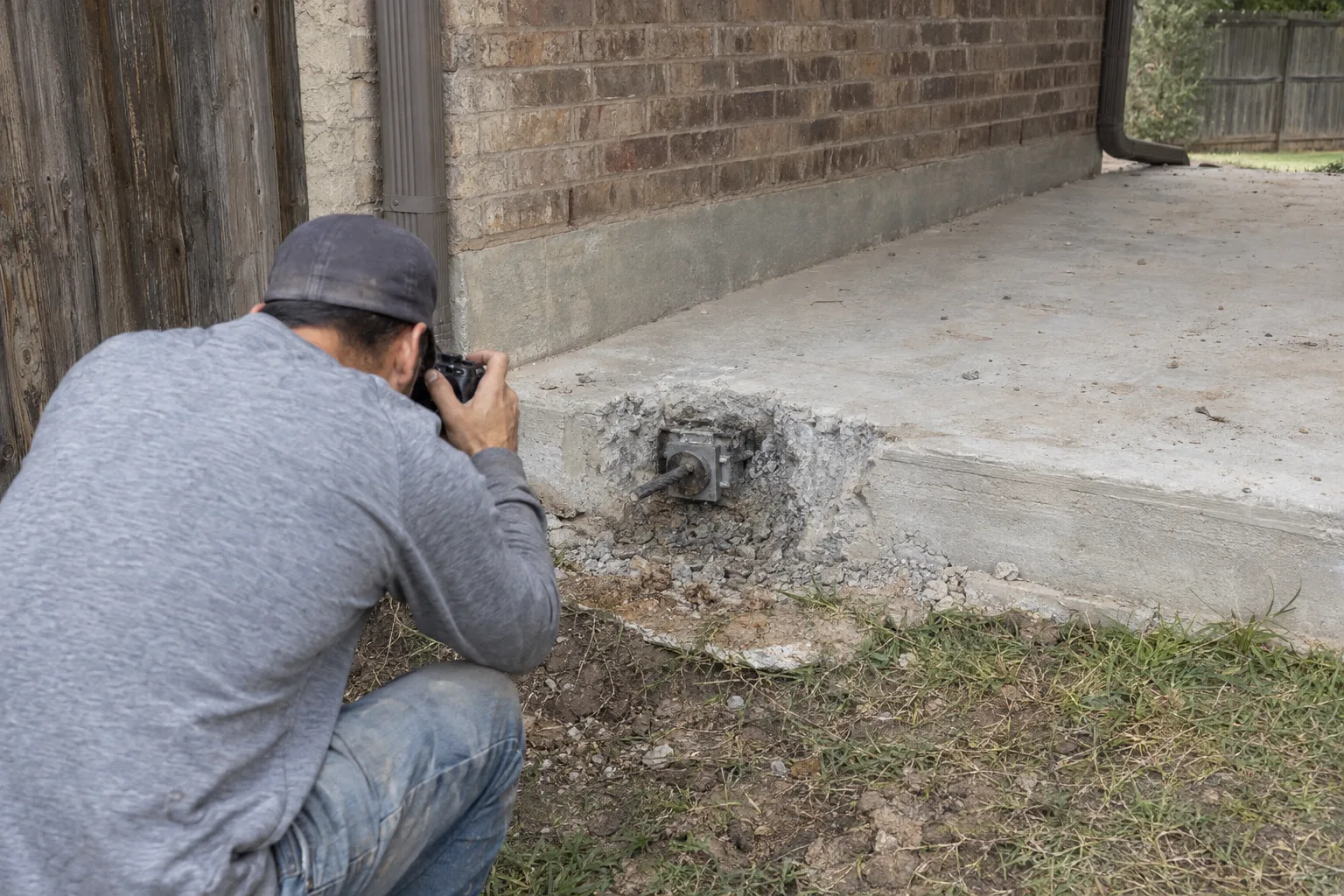
Before-and-after photo packages and failure-mode descriptions included with every repair.
Whether Your Policy Responds Often Comes Down to How the Damage Is Documented
Insurance coverage for a broken post-tension cable isn't automatic - it's earned through documentation.
Most homeowners have no idea this distinction exists until their claim gets denied. Getting the documentation right - from the first photo to the final repair record - is what separates a paid claim from a denied one.
Why Texas Homeowners File More PT Cable Insurance Claims Than Almost Any Other State
Dallas-Fort Worth's clay soil creates cable failure conditions that exist almost nowhere else in the country.
Here's what most homeowners don't realize about their foundation. DFW sits on Blackland Prairie soil - a highly expansive Montmorillonite clay that shrinks aggressively during drought and swells dramatically when rain returns. That cyclical movement stresses post-tension cables far beyond what engineers in other states design for. During Texas's 2011 drought and again in subsequent dry cycles, cable failures across Dallas, Garland, Mesquite, and Richardson spiked in ways that generated real insurance claim volume.
That history matters. Texas insurers know this market. Some policies have been rewritten specifically to address PT cable language because the claim frequency here is so much higher than the national baseline. When you file a claim in DFW, you're filing against an adjuster - the insurer's representative who reviews structural damage claims and determines coverage eligibility - who has likely reviewed PT cable claims before. They know what a thorough documentation package looks like. They also know what a weak one looks like.
A Phone Photo and a Verbal Quote - Why That Submission Gets Denied
I've seen this play out more times than I can count.
A homeowner discovers a broken cable - maybe during a plumbing repair, maybe after hearing a pop from under the slab. They grab their phone, take a few pictures of the exposed area, call their insurance company, and submit the photos with a contractor's verbal estimate. The adjuster reviews it and denies the claim. The denial cites a coverage exclusion (maintenance) - the policy provision that insurers use to reject PT cable claims they classify as long-term deterioration rather than a sudden event.
The homeowner calls me frustrated, thinking the insurer is wrong. Sometimes they are. But often the documentation just didn't support a sudden failure classification. Here's the problem: a cell phone photo of a broken cable shows the result, not the cause. It doesn't distinguish between a cable that snapped under acute soil stress and one that corroded over fifteen years from an open pocket. Those are two completely different events with two completely different insurance outcomes.
What an adjuster is actually looking for includes the condition of the surrounding concrete, the state of the anchor hardware, any visible corrosion pattern, the cable's position in the slab, and evidence of an acute mechanical event versus gradual degradation. I document all of that at the repair site before a single piece of concrete is removed. I photograph the failure zone, the anchor end condition, the pocket cover state, and the cable profile. I write a description of the failure mode that uses the right language - the kind an adjuster can place into their report.
One job in Richardson - a cable had snapped near the live end anchor, and the pocket cover was intact right up until the event. That intact pocket cover was key. It showed the system had been protected. No long-term moisture intrusion. Sudden failure. That detail, documented in writing with a close photograph, was the difference between a paid claim and a denied one. The homeowner's insurer approved the repair within ten days.
The documentation is part of the repair. It has to be.
Every Repair Comes With the Package an Adjuster Needs on the First Review
You shouldn't have to submit twice because the first package wasn't complete.
A repair documentation package - the structured set of written records, photographs, and material certifications that supports an insurance claim from initial assessment through completed repair - is included with every job we complete. Not as an add-on. Not as a separate service. It comes with the repair because the repair isn't done without it.
That means your adjuster gets everything on the first submission. Pre-repair photographs. A written failure-mode description. Post-repair confirmation photos. Material records for replacement components. If a claim denial appeal - the process a homeowner can pursue after an initial insurance denial - becomes necessary, that package is already assembled and ready. You're not scrambling to reconstruct what happened weeks or months after the work is done. The record exists because we built it while we were on-site.
This matters most in DFW because adjusters in this market have high claim volume and limited patience for incomplete submissions. The first review is the best chance to get it right.
What Goes Into a Complete PT Cable Claim Documentation Package
A complete documentation package covers the failure event from start to finish - before, during, and after.
Every repair documentation package we produce includes:
- Pre-repair site photographsWide-angle and close-up images of the failure zone, the slab edge condition, the pocket cover state, and the anchor hardware before any work begins
- Written failure-mode descriptionA plain-language explanation of how and why the cable failed, framed around the sudden and accidental classification that insurance policies respond to
- Anchor and pocket condition recordDocumentation of whether the anchor end (the hardware that secures the cable's tension at the slab edge) showed signs of acute failure versus long-term corrosion
- Material recordsSpecifications and certifications for all replacement cable material, meeting ASTM A416 strand standards
- Post-repair photographsConfirmation images showing completed anchor seating, pocket fill, and slab edge restoration
- Repair completion summaryA written record of the work performed, the methods used, and the final condition of the repaired area
Three things, not two. Photos, description, and materials record. All three together are what move a claim forward.
Sudden Failure vs. Maintenance Exclusion - How the Classification Gets Made
How an insurer classifies your cable failure determines whether the claim is paid or denied.
What "Sudden and Accidental" Actually Means
A sudden and accidental cable failure is one that occurred without warning, was not the result of neglected maintenance, and left visible evidence of an acute mechanical or environmental event. That's the event your homeowner's insurance policy (Texas) is designed to respond to. The language varies by carrier, but the concept is consistent: the damage was not foreseeable and not the result of the homeowner's failure to maintain the system.
For PT cables in DFW, that often means documenting soil-driven stress during a drought cycle, freeze event, or sudden soil re-expansion. These are real environmental causes - and they're the reason Texas sees higher PT cable claim activity than most states.
What the Maintenance Exclusion Covers
A coverage exclusion (maintenance) is the insurer's tool for denying claims on damage they can attribute to gradual deterioration. If the cable corroded slowly over ten years because a pocket cover was missing and water infiltrated the anchor, that's a maintenance argument. The documentation standard for rebutting that argument is specific: the pocket covers, the corrosion pattern, the cable profile, and the failure location all tell a story. If the story shows sudden mechanical failure rather than slow decay, the documentation has done its job.
How the Repair Record Shapes the Outcome
After completing the repair, the written summary and photographs become the primary evidence record. Post-repair images show what the repaired cable and anchor look like - confirming the work was done to standard. That evidence record is what supports a claim denial appeal if the initial submission is rejected. Many Texas homeowners have successfully appealed initial PT cable denials using detailed repair documentation. The appeal is only viable when the record was built correctly at the time of repair.
Insurance Claim Documentation for Dallas, Garland, Mesquite, Richardson, and All DFW Zip Codes
We serve the full Dallas-Fort Worth footprint - every zip code where PT slabs are common.
We complete PT cable repairs and produce insurance claim documentation packages across Dallas, Irving, Garland, Mesquite, Grand Prairie, Carrollton, Richardson, Farmers Branch, Duncanville, DeSoto, Cedar Hill, Balch Springs, Rowlett, Addison, University Park, and Highland Park. Our service area extends to Fort Worth, Arlington, Plano, Frisco, McKinney, Allen, Lewisville, Denton, Flower Mound, Rockwall, Wylie, Waxahachie, Waco, and all surrounding communities. If you have a PT slab in DFW, we come to you.
Get the Repair Done Right and the Paperwork Done With It
The repair and the documentation happen together - you don't have to manage them separately.
If you've discovered a broken cable or received a denial letter from your insurer, contact us at info@posttensioncablerepair.com. Describe what happened, include any inspection reports or adjuster letters you've already received, and we'll walk you through what a complete documentation package looks like for your specific situation. One call. One repair. One complete package for your adjuster.