What Does Post-Tension Cable Repair in Plano Involve?
Post tension cable repair in Plano restores a damaged steel cable inside your concrete slab. In most homes here, that cable is an unbonded single-strand tendon. That's a steel strand inside a greased plastic sleeve. The repair finds the damage and splices or replaces the strand. Then the crew pulls the strand back to tension. The result is a slab that carries its load as designed.
From 75074 to 75093: Plano Slabs Built on Blackland Prairie Clay
Plano homes sit on clay that swells when wet and shrinks when dry.
That soil is Blackland Prairie expansive clay. It runs under much of the city, from east Plano in 75074 to far-west 75093. Each wet-dry swing flexes the slab a little. The cables inside carry that stress every season.
Many homeowners don't realize how old much of the local housing is. Much of the city was built during its 1970s-through-1990s growth years. Those slabs are now decades into their cable service life.
The slab edge often sits in a watered flower bed. That puts moisture right where cables end.
There is one more local quirk. Most of Plano is in Collin County, and a western slice is in Denton County. Your county shows up on appraisal records. Building permits still go through the City of Plano either way.
A Call We Often Get From a Plano HOA Neighborhood
A typical Plano call starts with an inspection note, not a crisis.
Here's how it usually goes. A homeowner in a 75024 or 75025 neighborhood reads a line in their inspection report. It says a cable end looks wrong at the slab edge. Sometimes a strand pokes out near a flower bed. Sometimes a rust stain runs below a small square patch.
That patch is a PT pocket. It's the small opening at the side of the slab where a cable ends. Builders fill it with grout after the cable is stressed.
The first questions are rarely about steel. "Does my HOA need to approve foundation cable repair in Plano?" Then: "Do I need a permit to fix a post tension cable in Plano?" Both are smart questions. We start with an earlier one, though. Is this truly a cable problem?
We look at these signs first:
- A strand sticking out past the slab edge. A broken tendon can slide toward the pocket as it releases its force.
- Rust bleeding from a pocket. This often means water has reached the anchor.
- A straight crack running across the floor. It may line up with a cable path. Blackland Prairie clay movement cracks slabs too, so a crack alone doesn't confirm a cable problem.
- A loose or hollow pocket patch. Sometimes the cable is fine and only the pocket needs work.
Each sign points to a different job. A loose patch may only need pocket and anchor repair. A strand pushed past the slab edge usually means a broken post tension cable. That needs a splice or a new strand.
Sorting this out first keeps your HOA form accurate. You describe the real job, not a guess. If the signs are unclear, a cable inspection and condition assessment is the right first step.
Then planning gets simple. Scope first. Paperwork second. Work day third.
Your Short Checklist Before the Slab Edge Opens
Two calls come first: your HOA, then the city.
Many neighborhoods here use an HOA architectural review. In that process, owners tell the HOA about outside work. Some HOAs want a form filed before a crew or equipment arrives.
Permits are a separate question. Ask City of Plano Building Inspections, the city office that handles building permits. Rules depend on the job, so describe your exact repair when you call.
📋 Post-Tension Cable Repair in Plano, TX: HOA & City Checklist
☐ Your address and HOA name
☐ Which side of the house the work is on
☐ The inspection note, or a structural engineer (PE) report if you have one
☐ The digging area at the slab edge (plants, sod, mulch)
☐ Equipment expected on site (stressing uses a portable hydraulic jack)
☐ Planned work dates and your plan for putting plants and sod back
☐ The answer from City of Plano Building Inspections on permits
We Focus on Post-Tension Cables From Inspection to Replacement
Every service on our list is a post-tension service.
That covers inspection, pocket and anchor repair, re-stressing, repair, and full cable replacement. Your questions about the cable go to a team whose whole service list is this one system.
These are the trade standards behind good post tension cable repair in Plano:
- Strand quality:Home slabs in Texas typically use half-inch, seven-wire strand made to ASTM A416.
- Stressing force:A typical residential strand is stressed to roughly 33,000 pounds. That stored force is why stressing follows a strict sequence.
- Corrosion protection:Grease and sleeve coverage must be restored wherever the strand is spliced or exposed.
- Published specs:The Post-Tensioning Institute (PTI) publishes the standards for unbonded single-strand tendons.
- Pocket fill:Non-shrink grout is the standard material for sealing a PT pocket.
Ask: Who fixes post tension cables near Plano? Answer: A team that does post-tension work only.
How a Plano Cable Repair Moves From HOA Approval to a Sealed Pocket
Good repairs follow a set order: confirm, approve, repair, test, restore.
Before Work Day: Confirm and Plan
Step 1: Confirm the cable issue and find the damage. A broken post tension cable in Plano can sit near the slab edge or deep under the floor. Ground penetrating radar can map cable paths before anything is cut.
Step 2: Settle the engineer question. Ask: Does an engineer need to look at it? Answer: Sometimes. A structural engineer (PE) report is a review by a licensed engineer. Some jobs call for one, depending on how much damage there is and on local rules. Several broken cables or noticeable slab movement are common reasons to get one.
Step 3: Get the paperwork in hand. Have your HOA architectural review approval and the city's permit answer before work starts.
On Work Day: Open, Repair, Re-Stress
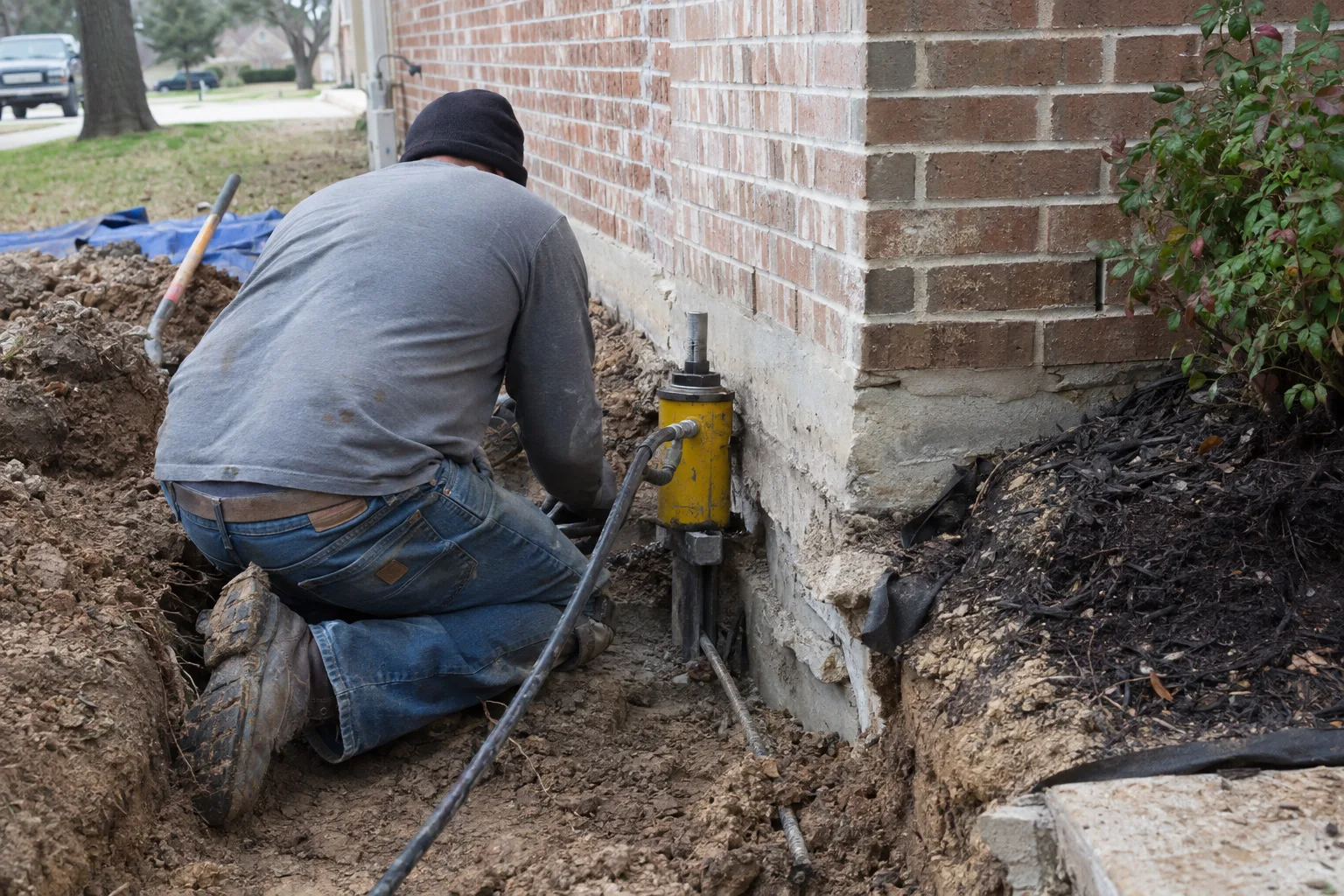
Step 4: Open the slab edge. A small trench exposes the PT pocket. The crew moves plants aside first. For a break near the edge, the crew cuts out the damaged length and joins in new strand with a coupler. A break under the floor may need access at that spot.
Step 5: Re-stress the strand. A hydraulic jack pulls the strand back to its design force.
After the Repair: Check, Seal, Restore
Step 6: Check, then seal. The crew measures how far the strand stretched and compares it to the expected value. That confirms the tension. Next, the crew cuts the tail and caps the end. The pocket gets non-shrink grout, and soil and plants go back.
One thing stays on your list. Re-tensioning restores the cable but doesn't close cracks that are already there. Crack sealing is its own finishing step.
Serving Plano ZIP Codes 75023 Through 75094 and Neighboring Cities
We serve all seven Plano ZIP codes and nearby cities.
That includes east Plano in 75074 and 75094, which borders the Murphy area. It covers central and north Plano in 75023, 75075, 75025 and 75024. Far-west 75093 is included too. Need post tension slab repair in 75024 or next door? We also serve Allen, Frisco, Richardson, Carrollton and McKinney. See our Dallas-Fort Worth post-tension cable repair hub for the full area.
Send Your Inspection Notes and Start With Clear Answers
Your best first step is sending us what your inspector found.
Whether you need post tension slab repair in 75024 or 75074, email info@posttensioncablerepair.com. Include three things: your inspection note, slab-edge photos, and your HOA name. That helps us sort out whether you're facing a cable, pocket or anchor job. From there, your HOA form and city call get much easier. Clear answers come first, so your post tension cable repair in Plano, TX, starts on solid ground.