Montmorillonite clay - the specific mineral that makes up the Blackland Prairie soil running beneath most of North and Central Texas - doesn't just sit still under a foundation. It absorbs water and expands. It loses water and contracts. It does this repeatedly, across every seasonal cycle, for the entire life of the structure above it.
What Montmorillonite Clay Does to a Post-Tension Slab Over Time
DFW's clay soil moves so dramatically that post-tension slabs experience more stress here than almost anywhere in the country.
That movement wouldn't be a problem if it happened uniformly. It doesn't.
Different sections of soil beneath a single slab dry out at different rates. One edge gets sun exposure. Another stays shaded. A section under a garden bed holds more moisture than the section under a driveway. The result is differential soil movement - where one part of the slab is being pushed up or pulled down while the adjacent section stays put.
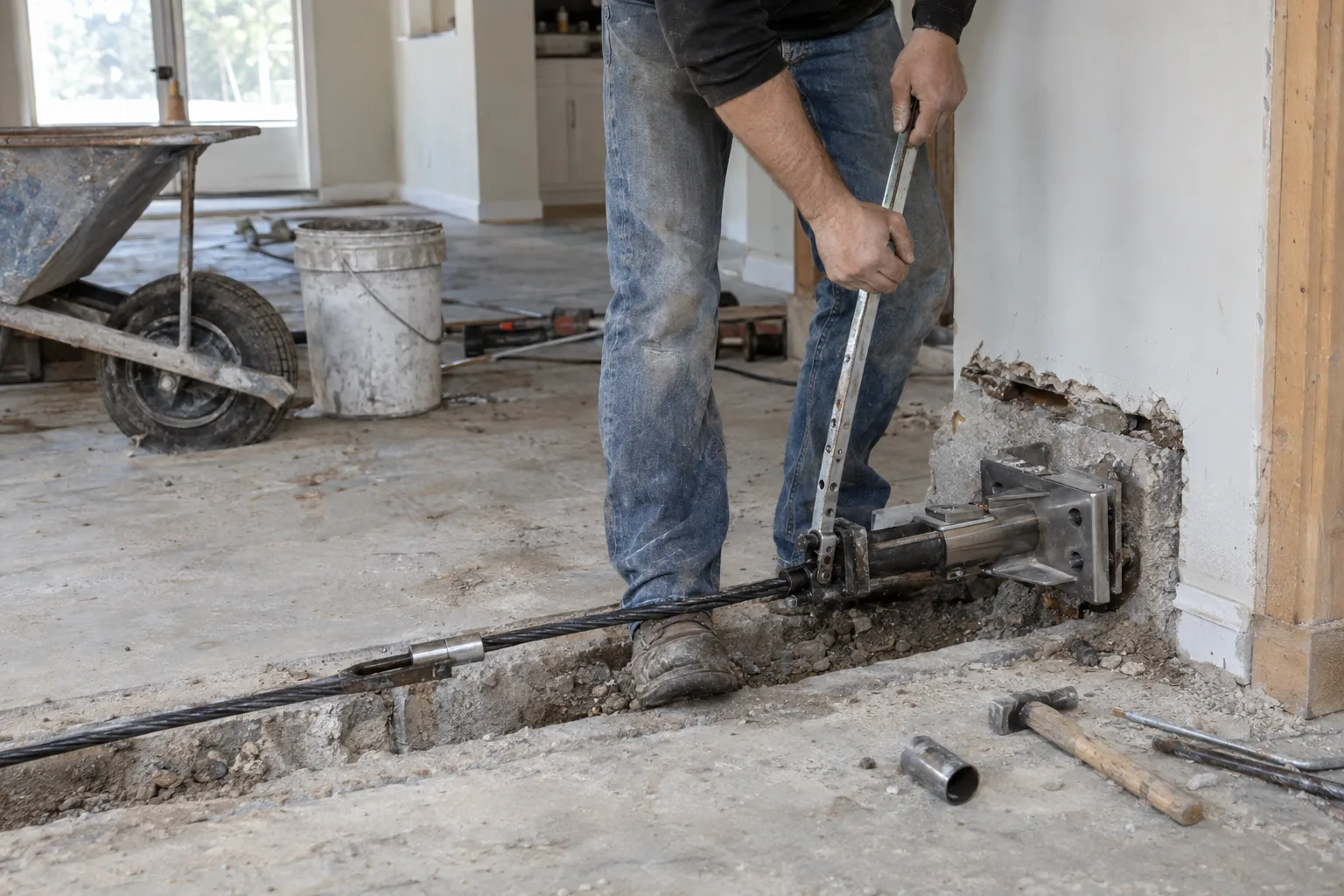
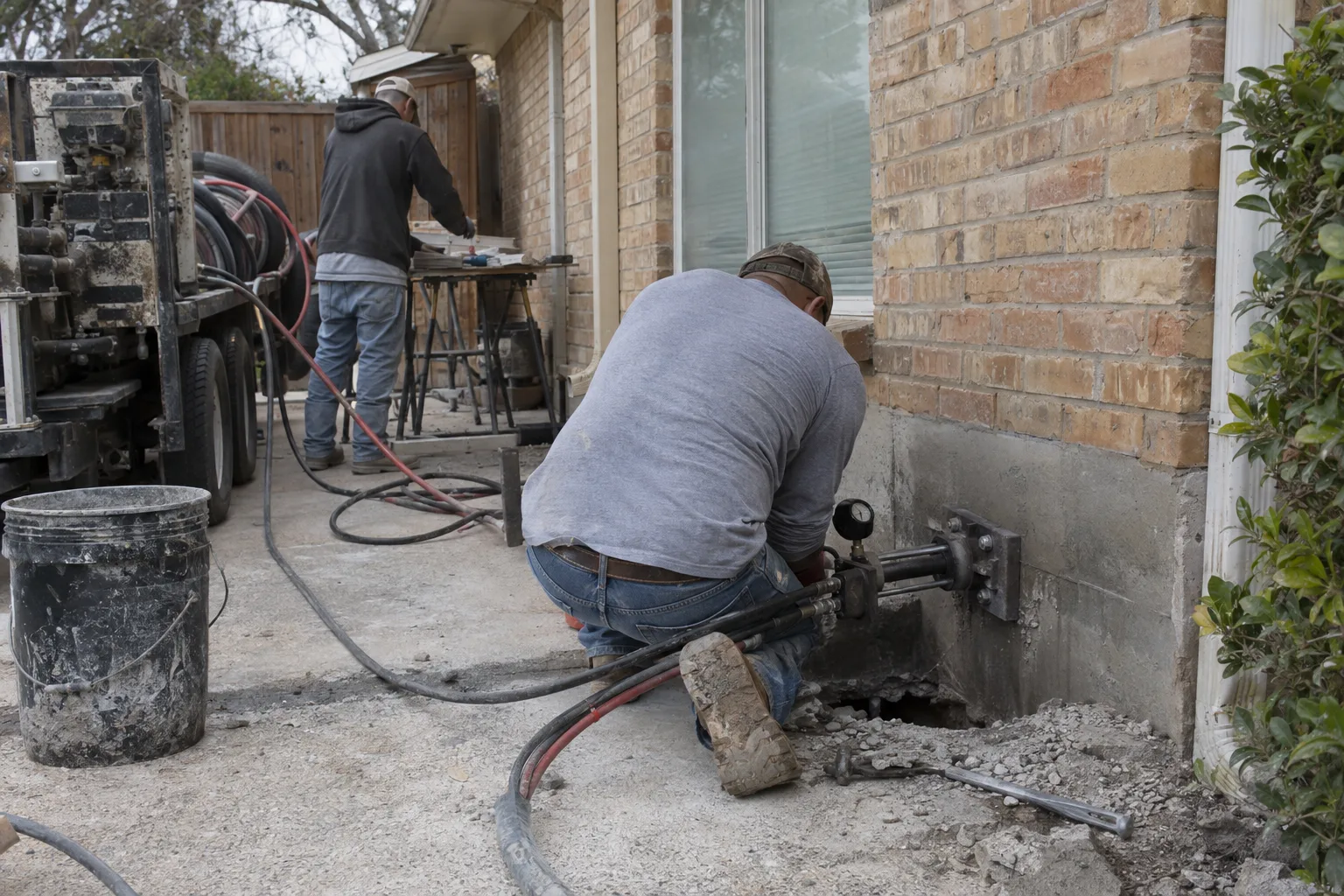
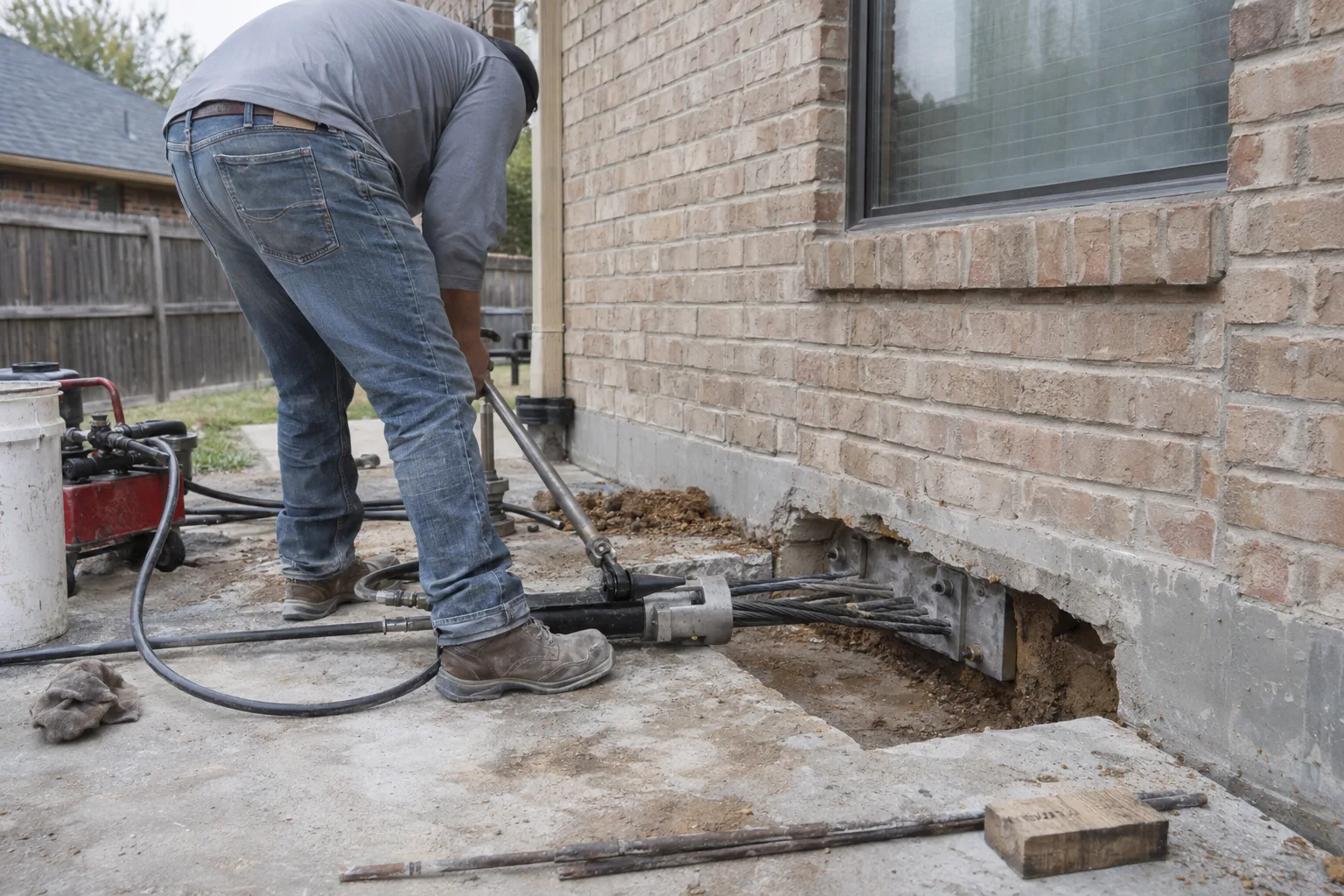
Post-tension cables (high-strength steel strands embedded in a concrete slab and tensioned to hold it in compression) are designed to handle a certain amount of bending stress. They are not designed for the volume and frequency of movement that Blackland Prairie clay produces. That gap - between design assumption and local reality - is why DFW slabs fail faster than slabs in most other states.
The Blackland Prairie Formation - Where It Runs, Which Counties It Covers, and Why It Matters
The geological formation beneath your DFW home is one of the most expansive clay deposits in North America.
The Blackland Prairie is not a local quirk. It's a band of Montmorillonite-dominant soil running roughly 300 miles north to south through Texas - from the Red River down through the Dallas-Fort Worth Metroplex, through Waco, and into Central Texas. The documented shrink-swell potential of this soil - called the plasticity index in engineering terms - routinely reaches 40 to 60 in DFW, compared to single-digit values in many other U.S. regions.
Here's what most homeowners don't realize about that number: a plasticity index above 30 is considered "highly expansive" in foundation engineering. DFW's Blackland Prairie soil regularly doubles that threshold.
Denton County. Dallas County. Tarrant County. Collin County. McLennan County down in Waco. All of them sit on this same formation. All of them produce the same failure patterns. A home in Plano, a home in Fort Worth, and a home in Corsicana are dealing with the same underlying geology - even though they may be 80 miles apart.
What changes by location is how drought and rainfall cycles hit each area in a given year. And that variation matters enormously for PT cable stress.
Drought, Re-Expansion, Cyclic Fatigue - The Three-Stage Process That Ends in Cable Failure
Post-tension cables in DFW don't usually fail in one event. They fail because of what happens across years of soil movement.
Stage One: Drought-Driven Desiccation
Drought-driven desiccation is the process by which prolonged dry conditions pull moisture out of clay beneath a slab. When DFW enters a drought - even a moderate one - the Blackland Prairie clay under a foundation begins to shrink. Volume reductions of 20 to 30 percent between fully saturated and fully dry states are documented in this soil type. That's not a small shift.
As the soil shrinks, it no longer supports the slab evenly. Sections of concrete begin to deflect. Post-tension cables are now being asked to span across unsupported zones they weren't designed for. Tensile stress in the cables increases. Corrosion is also accelerated - open soil gaps allow more air and moisture fluctuation to reach the slab edge, exposing anchor hardware and cable sheathing.
This phase is quiet. No visible crack necessarily forms. No loud pop. But the cable is being stressed beyond its design parameters, possibly every summer for years.
Stage Two: Re-Expansion After Rain
A re-expansion event - the rapid increase in soil volume when drought-dried clay is re-wetted - is the mechanical trigger that often breaks cables already weakened by desiccation.
The 2011 Texas drought was the most severe in recorded state history. The clay beneath DFW slabs contracted to its lowest moisture content in decades. Then, over subsequent seasons, rain returned. The soil didn't slowly re-wet. It expanded quickly. Slabs that had been sagging in the middle were now being pushed upward from below. Cables that had been under sustained tensile overload now faced compressive changes in the other direction.
The sequence of desiccation followed by rapid re-expansion creates a stress reversal - a cable being pulled one way and then pushed the other. Steel doesn't like that. Neither do anchor heads.
Stage Three: Cyclic Fatigue
Cyclic fatigue in PT cables is exactly what it sounds like. Repeated loading and unloading - not from one catastrophic event, but from dozens of smaller soil movement cycles across fifteen, twenty, or thirty years - gradually reduces a cable's structural capacity.
This is the failure mode that most homeowners never expect. Their cable didn't snap during a dramatic event. It simply ran out of remaining capacity on a Tuesday afternoon in August, after decades of seasonal soil movement. A single strand in a seven-wire cable gives way. Then another. Eventually, the whole cable loses effective tension.
DFW's climate cycle - hot dry summers, occasional hard freezes, rain events that break drought periods - isn't incidental to this process. It's the mechanism. The clay soil and the Texas climate work together to create conditions that PT cables in, say, the Pacific Northwest or the Upper Midwest are almost never subjected to.
What 2011 Looked Like for DFW Post-Tension Slabs - and What That Drought Wave Left Behind
The 2011 Texas drought produced a measurable spike in PT cable failures across the DFW Metroplex that is still generating repair calls today.
Texas A&M's Texas Forest Service documented 2011 as the driest single year in Texas recorded history. The Palmer Drought Severity Index - a standard measure of drought intensity - reached record levels across North and Central Texas.
For DFW's Blackland Prairie soil, it meant the worst possible version of Stage One. Soil moisture dropped to historic lows across Dallas, Tarrant, Denton, and Collin Counties simultaneously. Slabs that had been sitting stably for 20 or 30 years were suddenly unsupported across spans they'd never experienced before.
Three scenarios played out repeatedly across DFW neighborhoods during and after 2011:
The first was blowout. Cables that had been marginally stressed for years gave way suddenly. Homeowners heard a sharp bang from the slab edge. A chunk of concrete ejected. The cable tail shot outward from its pocket. These calls came in clusters.
The second was silent failure. Cables lost tension without any audible event. Homeowners noticed doors sticking, floor slopes developing, cracks widening at doorframes. When an inspection was done, cables that should have been at 33,000 pounds of tension were at a fraction of that - or effectively zero.
The third - and this is the one still producing calls now - was accelerated fatigue. Cables that survived 2011 came through weakened. The drought/re-expansion cycle from 2011 through 2015 chewed through their remaining service life. Many of those cables are failing today, 10 to 14 years later, and homeowners have no idea why their "newer" slab is suddenly showing problems.
That's the legacy of 2011. And it runs across the entire Blackland Prairie corridor - from Sherman and Denison in the north all the way down through Waco.
How Soil Condition Context Changes the Repair Recommendation
The same cable failure in two different soil conditions may need two different repair approaches.
When I look at a cable failure in a Dallas or Fort Worth home, the first question isn't just "what broke." It's "what was the soil doing when this broke, and what will it do next season?"
A cable that failed in a relatively stable section of slab - consistent soil moisture, no evidence of differential movement - has a very different repair profile than a cable that failed at the low point of a slab with documented differential settlement. In the first case, a targeted repair may hold for decades. In the second case, we need to address the soil-movement pattern alongside the cable repair - or the same section of slab will be back in trouble in five years.
Soil condition context also changes material recommendations. A cable replacement in an area with high chloride exposure from irrigation water - common in Plano, Frisco, and Southlake neighborhoods where irrigation systems run heavily - benefits from upgraded sheathing or corrosion inhibitor application at the pocket. A cable in an interior slab section with consistent moisture may not need that upgrade.
This isn't about adding cost. It's about matching the repair to the actual environment. DFW's clay soil doesn't allow for a one-size-fits-all approach. Every slab sits in a specific microenvironment shaped by soil type, irrigation habits, sun exposure, drainage patterns, and the local drought history. An assessment that ignores those factors is an incomplete assessment.
Signs That Soil-Driven Cable Stress Has Already Moved Past the Monitoring Stage
Certain patterns in a DFW home point to soil-driven PT cable stress that has gone beyond early warning.
Monitoring makes sense early. At some point, action makes more sense than watching. Here's how to read the difference.
Doors and windows that stuck seasonally - opening normally in winter, binding in summer - are an early-stage sign. That's the slab moving with the soil, which is normal to a degree. When that seasonal variation stops and the binding becomes permanent, the slab has moved to a new position and is not returning. That's past early warning.
Cracks at slab edges - especially cracks that appear near the pockets along the foundation perimeter - indicate that anchor hardware may already be under compromised conditions. If those cracks are growing between visits or showing rust staining, the corrosion process has accelerated.
A floor that has developed a noticeable slope - where a marble placed in the center rolls consistently toward one side - indicates differential settlement significant enough that cable tension may already be compromised in that section.
Any audible pop or bang from the slab edge, followed by visible concrete ejection or a protruding cable tail, is an immediate call situation. That's a blowout. It doesn't get better with monitoring.
If you're in DFW and your home was built between the 1970s and 1990s, your PT cables have been through multiple drought cycles. Getting a professional assessment - not just a foundation company's general inspection, but a PT-specific evaluation that accounts for soil conditions - is the right next step.
The Blackland Prairie Runs From Denton Through Dallas and Tarrant Down to McLennan County - We Cover All of It
Post Tension Cable Repair serves the full Blackland Prairie corridor and surrounding DFW communities.
We work across Dallas, Fort Worth, Arlington, Plano, McKinney, Frisco, Denton, Garland, Irving, Mesquite, Grand Prairie, Carrollton, Richardson, Rockwall, Wylie, Allen, Lewisville, Flower Mound, Grapevine, Southlake, Mansfield, and beyond. We also serve outlying areas including Waco, Sherman, Denison, Weatherford, Corsicana, and Stephenville. If your slab is on Blackland Prairie clay, we serve your area.
Get an Assessment That Accounts for What's Under Your Slab - Not Just What's In It
A soil-informed PT cable assessment gives you a clearer picture of what's happening and what will actually fix it.
Understanding that your cables are under stress is only part of the picture. Understanding why - what your specific soil is doing, what your local drought history looks like, and what that means for repair longevity - is what makes the difference between a fix that holds and one that doesn't.
Reach out to Post Tension Cable Repair at info@posttensioncablerepair.com to start a conversation about what's under your slab. We'll give you a straight assessment of what the soil conditions mean for your specific situation and what your options look like from there.