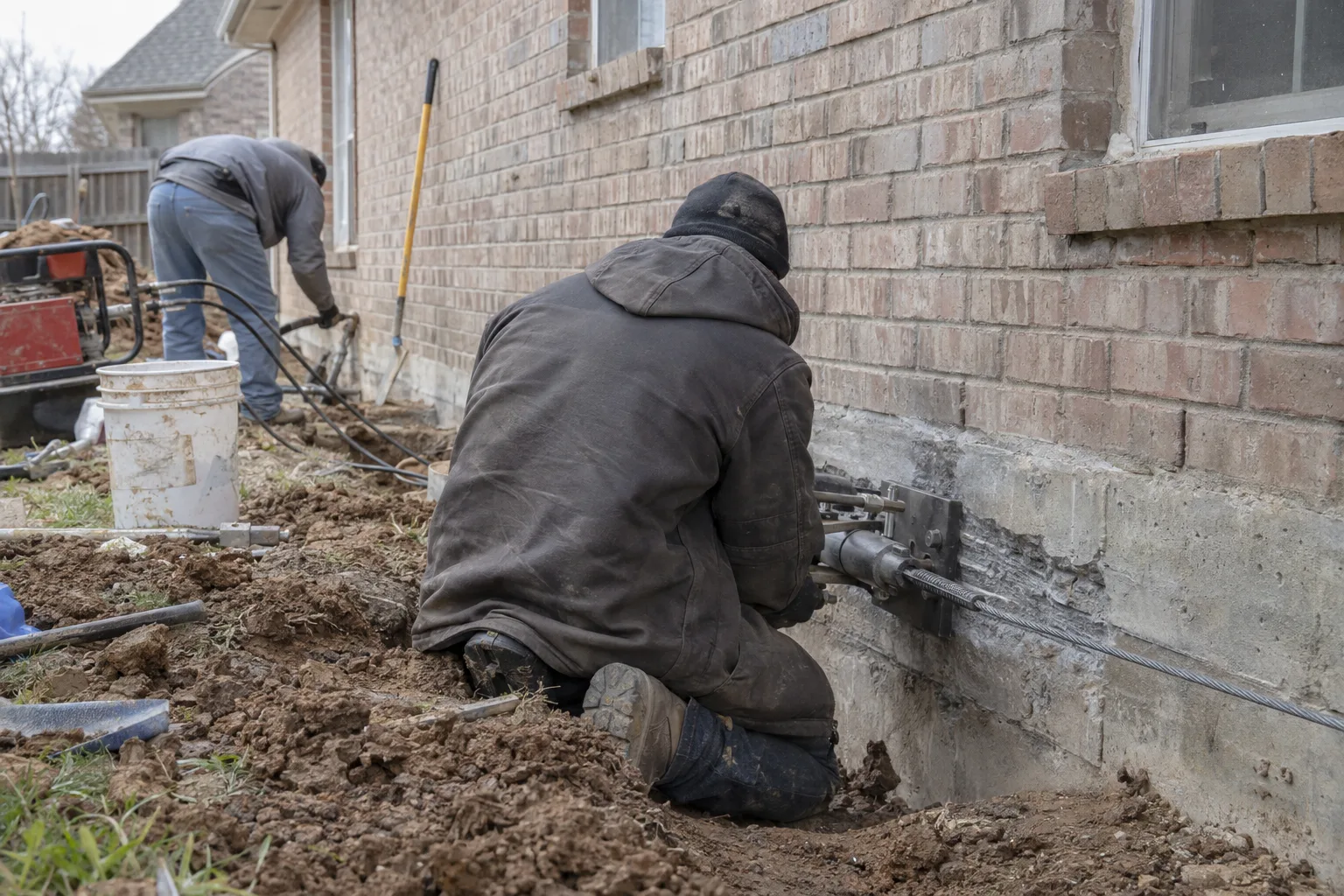
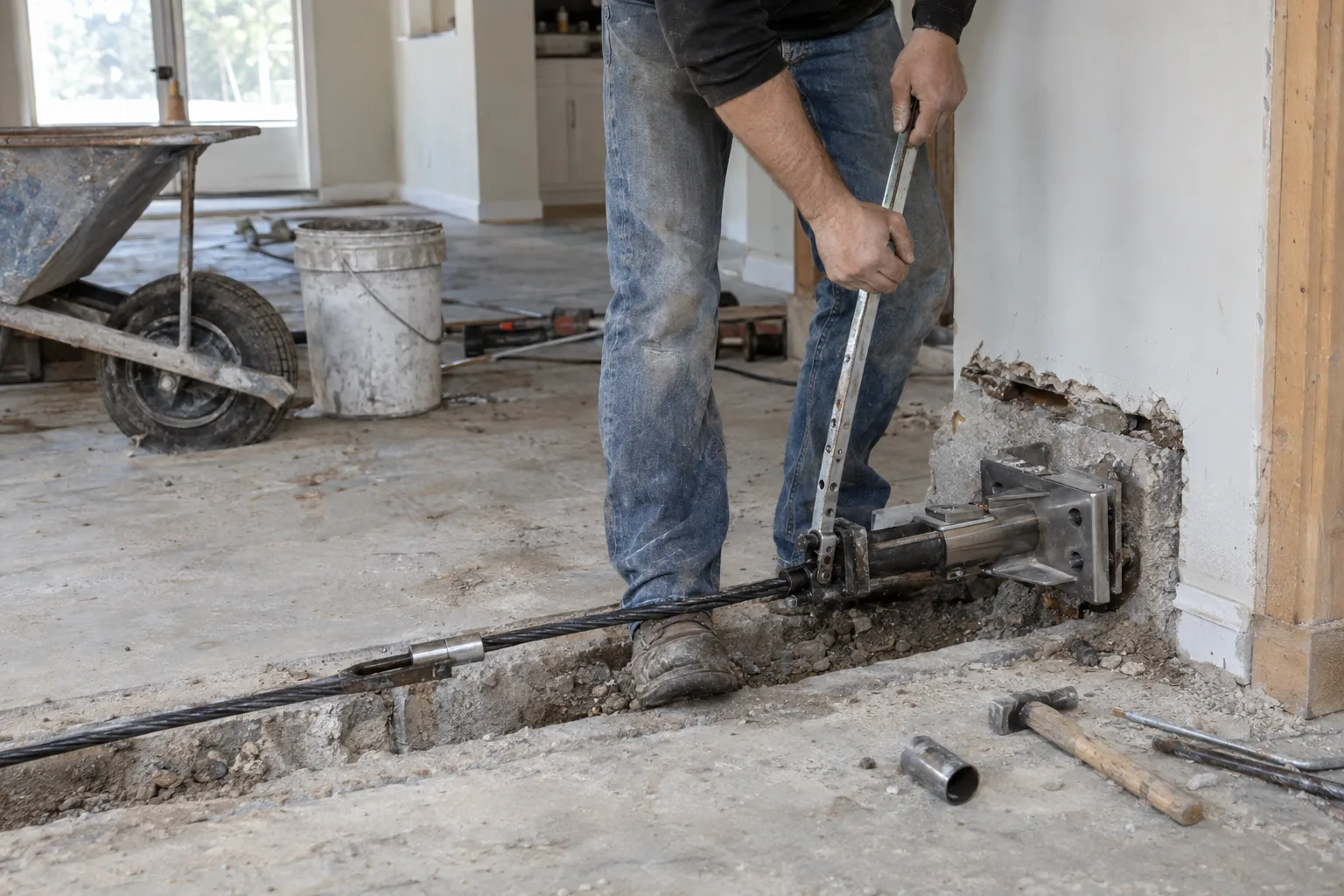
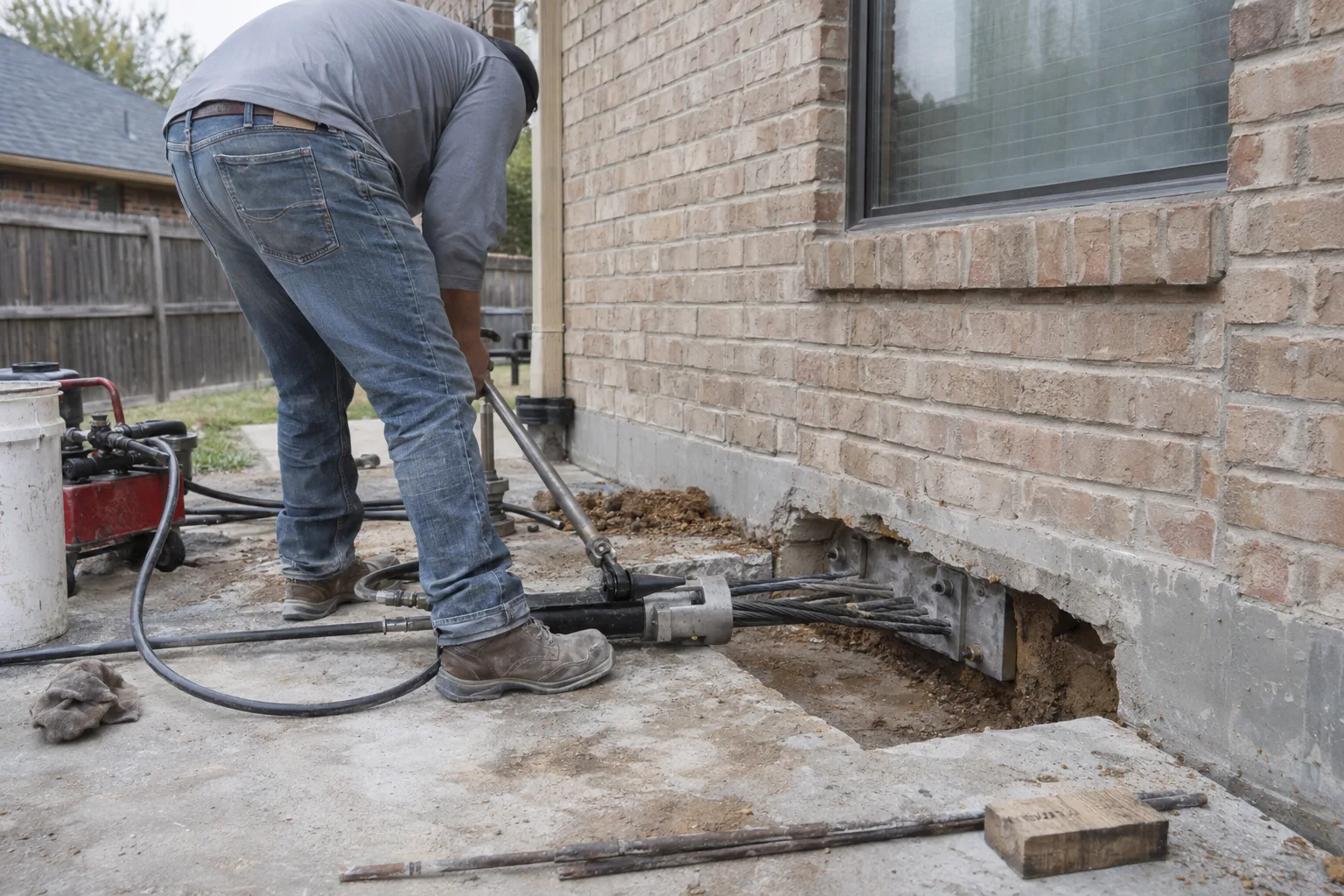
Era-specific sheathing and anchor hardware assessed alongside current slab condition.
Cable Age in DFW's Older Neighborhoods - What the Decades Actually Tell You
A post-tension cable's age tells you something. Not everything - but something worth knowing.
If your Dallas-area home was built between 1970 and 1999, the PT cable system underneath it is now somewhere between 25 and 55 years old. The designed service life of an unbonded single-strand tendon - the dominant PT cable type used in Texas residential construction, where each cable runs inside a plastic sheath filled with grease - is roughly 40 to 50 years under standard conditions.
DFW's conditions are not standard.
The Blackland Prairie clay soil beneath most of inner Dallas, Fort Worth, and their surrounding suburbs expands and contracts with rainfall and drought cycles more aggressively than almost any other soil type in North America. That movement compresses a cable system's effective timeline. It doesn't mean every 40-year-old cable is failing. It means the conversation about cable age and slab condition is worth having before the timeline makes the decision for you.
Irving, Garland, Oak Cliff, and Mesquite - Where the 1970s-1990s PT Housing Stock Is Concentrated
The inner ring of the Dallas-Fort Worth metro holds more aging PT slabs per square mile than anywhere else in Texas.
The post-tension construction boom in DFW tracked the region's first major suburban expansion. Neighborhoods built out between 1970 and 1995 in Irving, Garland, Mesquite, Oak Cliff, Grand Prairie, Carrollton, and south Dallas corridors like DeSoto and Cedar Hill are now home to tens of thousands of PT slabs from that era.
These aren't scattered homes. They're entire zip codes and subdivisions built within a five-to-ten-year window, with the same generation of cable system underneath nearly every structure on the block. When a neighborhood turns 40 or 45, its cable systems are turning 40 or 45 together.
Older Fort Worth neighborhoods - including established areas west and south of downtown - carry the same generational pattern. Many were built on expansive clay soils that have been cycling through wet and dry seasons for decades.
Here's what most homeowners in these areas don't realize about their slab: the year the house was built determines which cable generation is under it. And cable generations used very different materials.
How Each Construction Era Used Different Materials - and Why That Changes What We Look For Today
The decade your home was built determines which PT system is in your slab - and that matters for assessment.
Post-tension cable technology evolved significantly across the decades DFW was building its residential base. Era-specific PT systems - post-tension slabs built in different decades using different materials, sheathing types, and anchor hardware - aren't all assessed the same way. What we look for in a 1972 slab is different from what we look for in a 1991 slab.
1970s Systems: Minimal Corrosion Protection, Maximum Age
Cables installed in the 1970s were typically bare or minimally sheathed steel wire. Full plastic sheathing wasn't yet standard. Corrosion protection was limited - sometimes a light oil coating, sometimes nothing beyond the grease pocket at the anchor end.
Corrosion progression - the gradual degradation of PT cable steel through oxidation, pitting, or chemical attack - happens faster when sheathing is absent or degraded. Fifty years into an environment with seasonal moisture cycling, bare-wire systems have often accumulated significant pitting corrosion on individual wires within the strand.
That doesn't mean failure is imminent. It means a 1970s slab warrants assessment, not assumption.
1980s Systems: The Transition Decade
The 1980s brought meaningful improvements. Plastic sheathing became more common and more consistent. Anchor hardware improved. Many systems from this era used HDPE (high-density polyethylene) sheathing that holds up well - provided it wasn't cracked or pinched during installation.
In practice, 1980s slabs present mixed results. Some are in excellent condition after 35 to 40 years. Others show localized sheathing failure, particularly near bends or at points of repeated stress from soil movement. The anchor pockets - the small rectangular recesses at the slab edge where cable tails were cut and grouted - are often the first place visible deterioration appears.
1990s Systems: Improved but Approaching the Proactive Window
By the mid-to-late 1990s, PT cable systems in DFW residential construction were meaningfully better than their 1970s predecessors. Full plastic encapsulation was standard. Corrosion-inhibiting grease formulations improved. Anchor hardware was more consistently coated.
A 1995 slab is now 30 years old. That's not an emergency. But the pre-failure assessment window - the period in an aging slab's life when condition monitoring and targeted intervention can prevent more extensive failure - is open right now. It won't stay open indefinitely.
Waiting until something is visibly wrong closes the window for proactive re-stressing and targeted repair. By that point, replacement is often the remaining option.
Three Aging Patterns We Find on Slabs That Have Never Had a Recorded Repair
Aging slabs develop specific, recognizable patterns - and not all of them look dramatic from the outside.
Most homeowners in Irving, Garland, and Mesquite who contact us haven't seen a cable fail. They're calling because a neighbor did, or because an inspector flagged something at a sibling's closing, or because they simply did the math on their home's age.
Here are three patterns we find regularly on slabs that look fine until someone looks closely.
Pattern One: Pocket Deterioration Without Cable Failure
The grout pockets - small rectangular recesses along the slab edge where post-tension cable tails were cut after tensioning - are frequently the first sign of aging. Original grouting from the 1970s and 1980s can shrink, crack, or fall out entirely over decades. When pockets are open, moisture reaches the anchor hardware directly.
This is a repair that's genuinely straightforward when caught early. When left for another decade, that moisture pathway often leads to anchor corrosion that escalates the scope considerably.
Pattern Two: Tension Loss Without Visible Failure
Cables can lose a meaningful portion of their load-bearing force without breaking. This is called tension loss, and it doesn't announce itself with a pop or a crack. The slab simply performs less well than it was designed to - handling soil movement with less resilience than a fully tensioned system would.
Proactive re-stressing - applying controlled hydraulic tension to cables that have lost load-bearing force without fully failing - is available during the pre-failure assessment window. It's not available after a cable snaps.
Pattern Three: Localized Sheathing Failure at Soil Stress Points
Slabs built over Blackland Prairie clay develop consistent stress concentration zones - typically where differential soil movement is greatest, often near exterior corners or plumbing penetrations. In 1980s systems, plastic sheathing at these points sometimes cracks or separates over decades of repeated cycling.
We find these zones through a combination of visual inspection at the slab perimeter and assessment of the slab's movement history. The cable may still be intact. The sheathing failure is a warning that corrosion protection in that zone is compromised.
Reading a Decades-Old Slab Against Its Original Design Window
Every aging slab has a story written in its materials, its anchor pockets, and the soil history beneath it.
What I look for on a slab built in 1978 is different from what I look at on a slab built in 1993 - not just because one is older, but because they were built with fundamentally different systems. The 1978 system was designed with the materials and protection standards available at the time. We're assessing it now against 46 years of DFW soil cycles, drought seasons, and whatever renovation activity has touched that slab since.
The 2011 drought was particularly hard on inner-ring DFW slabs. Blackland Prairie clay dessicated to depths that caused differential movement far beyond the annual cycle. Cables that were already approaching the end of their design service life experienced stress concentrations during that period that accelerated their timeline. I've walked slabs in Garland and Mesquite where the soil history of that drought is literally readable at the slab edge - open pockets, spalled corners, and anchor hardware that shows oxidation patterns consistent with that period of extended dryness.
None of that is cause for alarm on its own. It's information. And information read against a cable's generation and estimated remaining service life gives a homeowner something genuinely useful: a realistic picture of where their slab stands, not a worst-case scenario and not false reassurance.
The goal of a condition assessment on an aging slab is to close the uncertainty gap. You shouldn't need to guess whether a 1983 cable system in Irving is worth proactive attention. The answer should come from looking at it.
The Condition Signals That Mean the Proactive Window Is Still Open - and When It's Closing
Visible pocket deterioration and tension loss without snapping are the clearest signs the proactive window is active.
If any of these apply to your home, a condition assessment is a productive use of time - not a crisis response:
- Your home was built between 1970 and 1995 and has never had a PT cable inspection or recorded repair
- You can see open, missing, or crumbling grout pockets along the edge of your slab
- A home inspector or engineer flagged PT-related findings during a transaction or remodel
- Doors are sticking or floor elevations have shifted noticeably in the past three to five years
- Your neighborhood has had significant drainage or landscaping changes that altered soil moisture patterns
The proactive window begins closing when corrosion has progressed beyond the sheathing into the cable wire itself. At that stage, re-stressing is no longer viable and targeted repair becomes more complex. When anchor hardware has corroded to the point of structural compromise, replacement is typically the remaining path.
An assessment now gives you clarity on which side of that line your slab sits on. That clarity is worth having - especially for a home in an inner-ring DFW neighborhood where the cable generation and local soil history are known factors.
Aging Slab Assessments From Inner Dallas and Fort Worth Through DeSoto, Cedar Hill, and Rowlett
We work across every aging-slab corridor in the DFW metro - no reduced service tier for outlying neighborhoods.
We serve the full inner ring and surrounding communities, including Irving, Garland, Mesquite, Grand Prairie, Carrollton, Richardson, Farmers Branch, Oak Cliff, Duncanville, DeSoto, Cedar Hill, Balch Springs, Rowlett, and established Fort Worth neighborhoods. We also cover Rockwall, Sachse, Wylie, and south-corridor communities including Lancaster and Waxahachie. If your home was built in this region between 1970 and 1999, we work in your zip code.
Get a Condition Read on Your Slab Before the Timeline Makes the Decision for You
The proactive window on a 1970s-1990s PT slab is open now. It won't stay open on a fixed schedule.
You don't need a visible cable failure to have a useful conversation about your slab's condition. If your home was built before 2000, the cable generation underneath it is worth understanding - especially in a DFW neighborhood where soil movement has been cycling for decades.
Reach out to Post Tension Cable Repair at info@posttensioncablerepair.com. Tell us your neighborhood and approximate build year. We'll give you a straight read on what that system's age and local history typically look like - and whether a condition assessment makes sense for your specific slab.