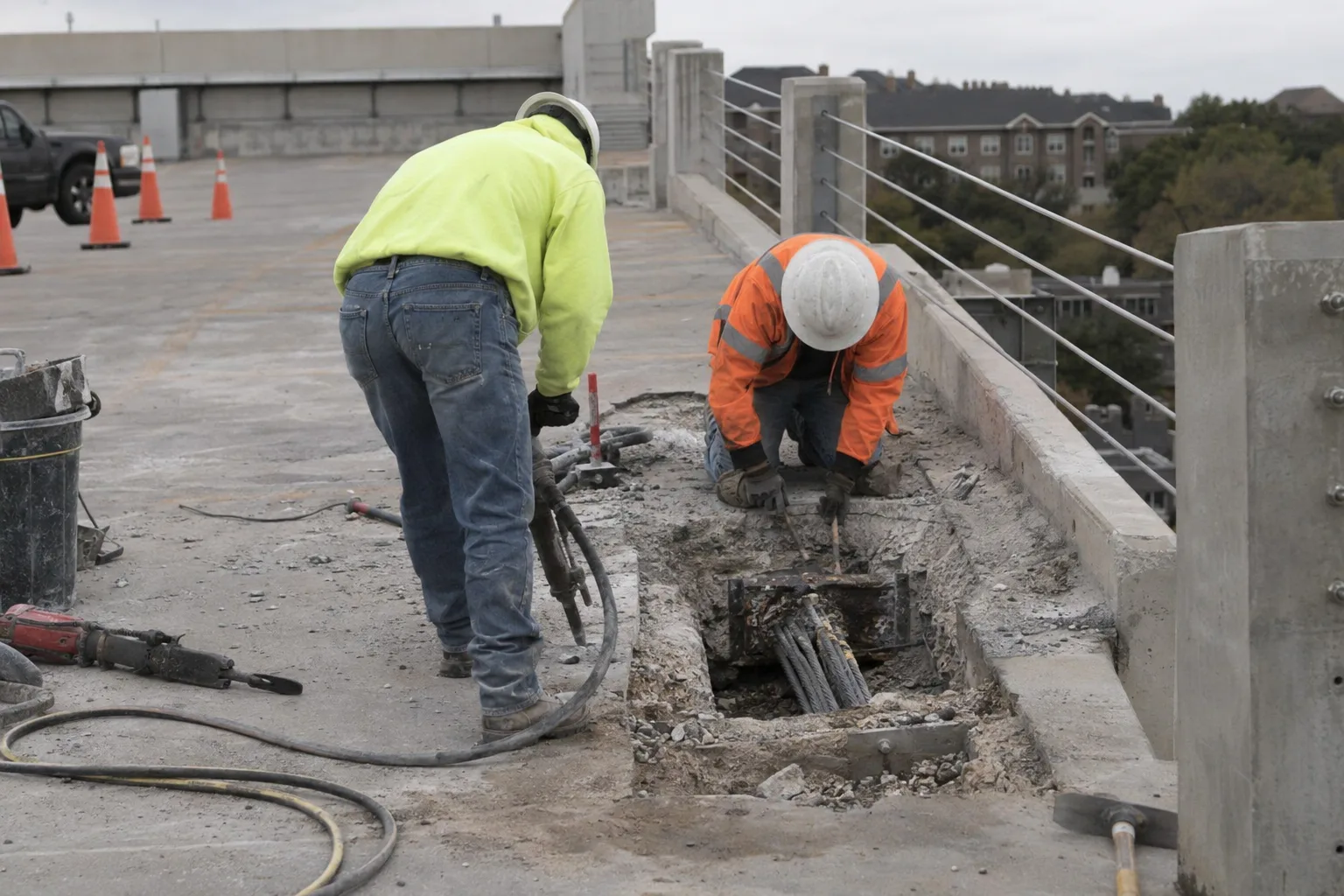
Phased repair scopes keep your property operational throughout the entire project.
What Commercial PT Cable Repair Covers - and What Makes It Different From Residential Work
Commercial post-tension cable repair is a distinct discipline - not a scaled-up version of residential work.
Commercial PT cable repair in Dallas-Fort Worth also answers to more stakeholders. The structural engineer of record (the licensed PE who originally designed and stamped the building's structural drawings) typically must review and approve any repair scope. Lenders, insurers, and code enforcement may all have standing requirements. The page on your inspection report isn't just a repair directive. It's the beginning of a documentation chain.
We build that chain from the first site visit forward.
Office Parks, Parking Garages, and Warehouses - DFW's Commercial PT Problem in Plain Terms
DFW's commercial PT inventory is aging - and the failure patterns are predictable once you know the soil.
Here's what most facilities directors don't realize about DFW's commercial PT environment. The Blackland Prairie clay that runs under most of the metroplex - from the industrial corridors along I-20 and I-30 to the office parks in Las Colinas and the warehouse districts east of I-635 - expands and contracts more aggressively than almost any soil type in North America. A multi-level parking structure built on that clay in the 1980s or 1990s has experienced decades of differential movement underneath it.
That movement doesn't break cables in a single dramatic event. It fatigues them. Pitting corrosion starts at the anchor pockets. Moisture works through degraded grout. By the time an engineer flags a cable on a condition report, two or three adjacent cables have often been quietly compromised for years.
Properties in the high-density commercial zones along Preston Road, the Stemmons Corridor, and Airport Freeway in Irving see this pattern repeatedly. The good news: phased commercial PT repair - a repair plan divided into sections so portions of the structure remain in use while other sections are actively under repair - is built exactly for this scenario.
When a Lender Flags a Structural Report and the Clock Starts Ticking
A lender flag on a PT deficiency report is a business problem, not just a structural one.
I've seen this exact scenario play out more than once on commercial properties across DFW. A property owner is refinancing or selling a mid-rise office building near Uptown Dallas. The commercial lender requires a structural inspection as part of due diligence. The engineer's report comes back with two flagged items: deteriorated grout pockets on the building's second-floor post-tensioned slab edge, and one confirmed broken cable on the east parking deck.
The lender's position is simple. The deficiencies must be repaired and documented before closing can proceed. The timeline is six weeks.
Here's where it gets complicated. The building has a full tenant roster. The east parking deck services three ground-floor retailers with active leases. Shutting down the deck entirely for a standard mobilization isn't a viable option - the tenants have contractual access rights.
What we built for that project was a phased repair scope document - a repair plan broken into two sections with defined start, completion, and access restoration milestones for each. Section one addressed the grout pocket restoration and anchor hardware on a Saturday-Sunday window when retail traffic was minimal. Section two, the broken cable repair on the deck, was completed in a single early-morning mobilization before businesses opened.
The repair documentation package - before/after photography, material certifications for the replacement strand, tension verification records, and a PE correspondence letter - was delivered within five business days of completion. Closing happened on schedule.
That's what a commercial PT repair engagement looks like when it's structured correctly from the first call.
Facilities Directors Get a Written Scope - Not a Verbal Walk-Through
Every commercial engagement starts with a written scope document - before any work is authorized.
Verbal estimates and handshake agreements don't work in commercial PT repair. Your maintenance budget requires line items. Your lender requires documentation. Your tenant leases may require advance notice of any work affecting common areas or access.
We produce a written scope for every commercial project. That document defines the repair locations, the access requirements, the phasing plan, materials to be used (including strand grade meeting ASTM A416 specifications - the industry standard for post-tension replacement steel), and the documentation deliverables at close of work.
If your building has a structural engineer of record on file, we coordinate directly with that engineer to ensure the repair scope aligns with their structural drawings and approval requirements. You don't manage that back-and-forth. We do.
The result is a commercial PT cable repair documentation package that satisfies your lender's structural requirements, supports any active insurance claim, and goes into your building's permanent maintenance records.
How Commercial PT Repairs Get Planned, Phased, and Coordinated
Commercial PT repairs follow a defined planning sequence - not a residential field call workflow.
Our commercial process follows PTI DC80.3 standards for unbonded single-strand tendons - the dominant system in Texas commercial construction.
What our commercial engagements include:
- Initial site assessment with photo documentation of all visible PT pocket, anchor, and cable conditions
- Written phased repair scope aligned to your tenant schedule and access constraints
- Coordination with the structural engineer of record (or referral to a qualified PE if none is on file)
- Repair execution using certified replacement materials meeting ASTM A416 strand specifications
- Post-repair tension verification with documented load readings
- Concrete pocket restoration and grout finishing at all repair locations
- Final PT cable repair documentation package for lender, insurer, and building file
Three documents. Not just the invoice.
Section by Section - How We Move Through a Commercial Property Without Disrupting Tenants
We sequence commercial PT repair work around your building's operational calendar - not ours.
Diagnostics
We start with a full review of available structural drawings, prior inspection reports, and any engineer correspondence already on file. This prevents redundant assessment work and aligns our scope to documentation that already exists. If GPR scanning is needed to locate cable positions before drilling or coring, we coordinate that prior to mobilization.
Implementation
Work proceeds by section according to the phased scope document. Each section has a defined access window - nights, weekends, partial floor closures - determined in coordination with property management. Adjacent occupied areas are protected with appropriate dust barriers and access controls throughout.
Post-Service Testing and Documentation
Every repaired cable receives tension verification before the repair pocket is permanently grouted. Load readings are logged and included in the final documentation package. If the structural engineer of record requires a site visit or inspection sign-off, that is scheduled before the documentation package is closed. You receive a complete, organized file - not a folder of loose photos.
Commercial PT Repair Across the DFW Metroplex - From Las Colinas to the I-20 Industrial Corridor
We serve commercial properties throughout the full DFW metro and surrounding markets.
Active service areas include Dallas, Fort Worth, Irving, Arlington, Plano, Frisco, McKinney, Denton, Garland, Mesquite, Grand Prairie, Carrollton, Richardson, Farmers Branch, Addison, Grapevine, Southlake, Colleyville, Mansfield, Rockwall, Lewisville, Flower Mound, Euless, Bedford, Hurst, Weatherford, Waxahachie, Corsicana, Waco, and all points between.
If your property is in the DFW footprint, we're on it.
Request a Phased Repair Plan for Your Property
Commercial PT cable repair in Dallas-Fort Worth starts with a written scope - not a sales call.
Send your engineering report, your building type, and your timeline to info@posttensioncablerepair.com. We'll review the documentation and respond with a preliminary assessment of phasing options and coordination requirements. No verbal walk-throughs. No surprises. Just a clear plan your team and your lender can rely on.