# Denton Post-Tension Cable Repair That Keeps Your Rental Records Straight
What Does a Cable Repair Mean for a Denton Rental?
It means a working slab and a clean record you can file.
Post tension cable repair in Denton restores the steel cable that holds your rental's slab together. This page is for owners who lease houses or duplexes in town. The cable goes back to work. You can also pair the repair with our insurance claim documentation service, so both move forward together.
Post-Tension Slabs in the Rentals Around UNT and TWU
Many Denton rentals near campus sit on post-tension slabs worth checking.
Denton is home to the University of North Texas and Texas Woman's University. The streets around both campuses are full of rental houses and duplexes. Plenty of them sit on post-tension slabs.
Many out-of-town owners don't realize that not every rental near campus has one. Many older homes sit on pier-and-beam foundations instead. Newer slab-on-grade houses and duplexes are more likely to be post-tensioned.
The ground matters too. Denton County mixes sandier soils with heavy clay, sometimes within a short drive. Clay swells when wet and shrinks in drought. That cycle puts steady load on the cable.
For your records: Before you book post tension cable repair near UNT, confirm the slab type. Look at the garage floor and the slab edge. Many post-tension homes have a warning stamped into the concrete. Small grouted patches along the slab edge are another clue.
A Typical Landlord Call, From Tenant Report to Closed File
Most landlord calls follow the same four steps, start to finish.
A call we often get from Denton owners goes like this. The owner lives in Dallas, or across the state. Their tenant near UNT sends a text about a new crack in the tile. Or a sharp pop under the floor one evening.
Step one: the tenant report. Save that message exactly as it came in. Note the date and the tenant's own words. You'll want both later.
Step two: the site look. We check the slab edge, the pockets, and the cracks the tenant described. Sometimes a tendon end has pushed out past the slab edge, which often points to a broken post tension cable. A tendon here means an unbonded single-strand tendon. That's a steel cable in a plastic sheath, pulled tight after the concrete sets. It's the part of your slab you're paying to fix.
Sometimes a crack is just a crack, and we say so plainly.
Step three: the repair. While the repair is planned, owners almost always ask one question: "What will my insurer want?" We don't guess at coverage. We suggest two questions for your agent instead.
For the insurer: First, which policy covers this house? A rental is often on a dwelling or landlord policy. That's a policy written for a home you rent out, not one you live in.
Second, does the insurer treat this as a sudden or a gradual loss? Insurers often handle a sudden event differently from slow wear. Your agent can tell you how your policy reads.
Step four: the file. The repair and the claim documentation move forward together. You end up with one record. It can support a landlord insurance claim for a post tension cable now, or a sale later.
Clear Answers You Can Pass Along to Your Tenant
Your tenant gets plain facts, and you get a calm, documented process.
Many tenants near campus have never heard of a post-tension slab. That's normal, and we explain the cable in words anyone can follow.
For the tenant: The cable is a steel strand that squeezes the slab together. The repair targets that one strand at one marked spot.
For you: Texas Property Code Chapter 92 sets a landlord's repair duties for residential rentals. It's one reason owners act on tenant reports right away. Confirm the details with your own attorney or advisor.
One Denton detail is worth planning around. Many leases near UNT and TWU turn over in summer. A broken post tension cable in a rental house found mid-lease means planning access with your tenant. In a duplex, one tendon can run under both units. Both tenants may need a heads-up.
For your records: Note which units share the slab and when each lease ends.
How We Pair the Repair With Your Claim Documentation
The repair and your claim paperwork run side by side, not separately.
Our post-tension cable insurance claim documentation is its own defined service. You can add it to any post tension cable repair Denton job. Here's how it stays organized:
- One scope, one record.The repair and the documentation cover the same cable at the same spot.
- Your policy, your questions.Ask whether your dwelling policy treats this as sudden or gradual loss. We make no coverage promises.
- Specialist work only.Post-tension cable work is the whole of our service list.
- Engineer input when asked.Some insurers or buyers want a structural engineer (PE) letter. That's a written opinion about the slab from a licensed engineer. Ask your insurer early whether they need one.
- Built for resale.Texas sellers fill out a Seller's Disclosure Notice. That's the form listing known conditions of a home. A clean repair file makes that form easier to complete.
Locate, Open, Repair, Restore: The Work in Order
Every repair follows the same order, from finding the cable to restoring the surface.
Locate the Damaged Tendon
First, we trace the damaged tendon's path across the slab. That's the unbonded single-strand tendon described above. The goal is to find the exact trouble spot so nearby cables stay untouched. We then mark the repair point on the concrete.
In a duplex, the trace can cross under both units. That's normal for a long tendon.
Open, Splice, and Re-Tension
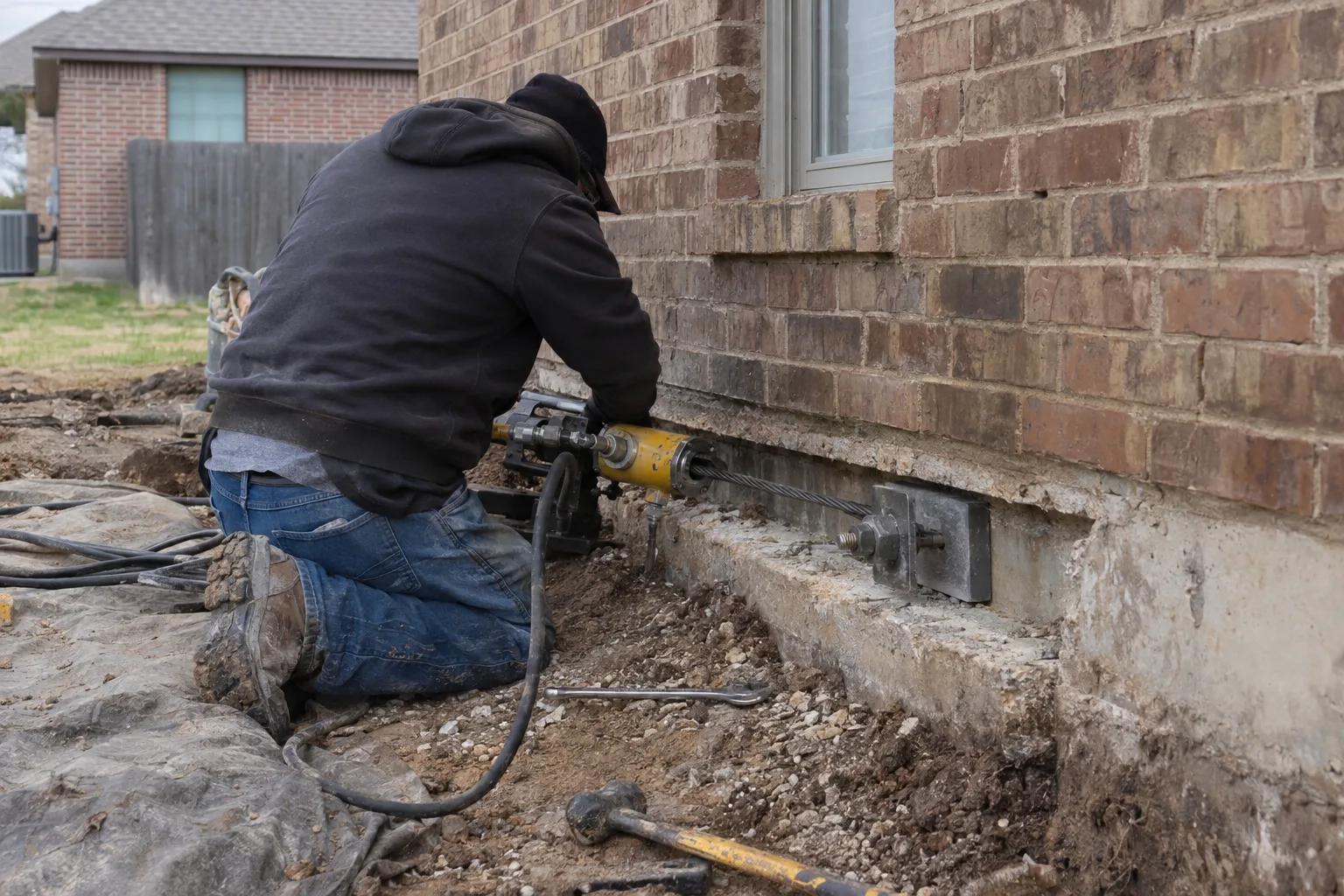
Next, we open the concrete over the damaged section only. We cut out the failed length of strand and splice in a new length with couplers.
Then we pull the cable back to tension with a hydraulic jack. The anchor holds that tension. That's the hardware at each end of the cable. The live end is where the jack pulls, and the dead end stays fixed. If either anchor is worn, we replace it. Our pocket and anchor repair page covers that work in more detail.
Check, Seal, and Restore
We check the tension against the slab's design force. We also measure strand stretch during stressing to confirm the pull. Then we trim the cable tail and fill the pocket around the anchor to keep moisture out. Finally, we patch the opened concrete and restore the surface.
For your records: File the repair date alongside the tenant's original report.
Denton, Lewisville, Flower Mound, and North Along I-35
We serve Denton and the cities around it in every direction.
Our post tension cable repair Denton TX service covers rentals near UNT, TWU, and across town. We also work in Lewisville, Flower Mound, Gainesville, and Decatur. To the east, we serve Celina, Prosper, Frisco, and McKinney. Our main Dallas-Fort Worth post-tension cable repair page lists the full metro.
Next step: If your rental's town isn't listed, email us the property address.
Start a Repair File for Your Denton Property
One email starts both the repair and the record.
Email info@posttensioncablerepair.com with the property address and what your tenant reported. Tell us if you'd like documentation paired with your post tension cable repair in Denton, TX.
Records to keep:
- The tenant's original report, with the date
- Your dwelling policy's declarations page
- Every note or message from your insurer
- Our repair and documentation records
- A PE letter, if your insurer or buyer asks for one
- A copy of everything for your future Seller's Disclosure Notice
Landlord Questions About Cable Repairs and Claims
**