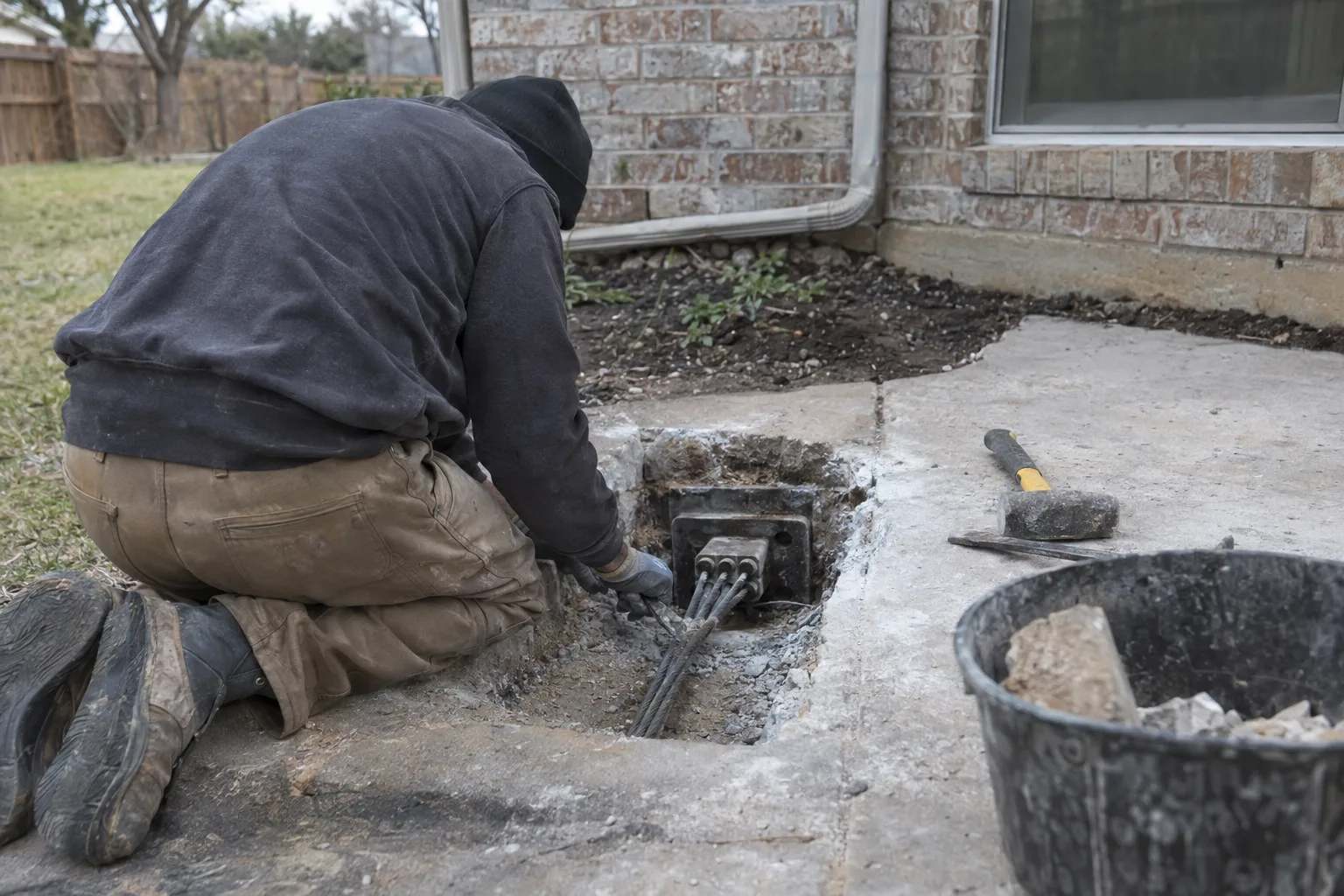
What Caused That Bang - and What Your Slab Just Did
A snapped post-tension cable is a sudden structural event - but it's also a diagnosable, repairable one.
You heard something loud. Maybe it felt like it came from underneath the floor. Maybe a chunk of concrete popped away from the edge of your slab. That event has a name: a cable snap event - the sudden failure of a post-tension cable under accumulated stress. When a post-tension cable (a high-strength steel strand stretched under thousands of pounds of tension to hold your concrete slab together) reaches its breaking point, it doesn't fail quietly. The stored energy releases instantly. That's the bang.
Here's what most Dallas homeowners don't realize in that moment: the snap itself is the event. The danger window is usually narrow and contained. What matters now is understanding what happened, where it happened, and what your slab looks like at the edge. Those three things tell us everything we need to know before we come out to you.
Reach out now. The first conversation is triage - not paperwork.
DFW Soil Cycles and Why Snap Events Peak After Drought Breaks
Post-tension cable snaps in Dallas-Fort Worth follow a predictable pattern tied directly to the soil beneath your slab.
DFW sits on Blackland Prairie clay - a highly expansive soil type that shrinks aggressively during dry months and swells hard when moisture returns. During a drought, that clay pulls away from the underside of your slab. The slab loses support in sections. The cables inside carry more load than they were designed for.
Then the rain comes.
When the soil re-expands after a drought breaks, it doesn't push evenly. Some sections of the slab lift. Others stay low. That differential movement puts intense tensile stress on cables that may already be near their limit. Snap events across the Dallas metro - in areas like Garland, Mesquite, and older Irving neighborhoods - historically spike in the weeks following a rainfall surge after a dry period. The 2011 drought followed by its eventual break generated a wave of cable failures across the region that repair teams were still addressing years later.
If your slab snap happened this spring or fall, the soil cycle almost certainly played a role.
From Loud Bang to Blowout - Recognizing the Full Snap Event
Every snap event tells a story. Reading it right determines what the repair scope actually is.
Here's how I walk through a snap call when it comes in.
The homeowner describes a loud pop - sometimes mistaken for a gunshot or something falling inside the house. I ask two things immediately: where in the home did it sound loudest, and have they walked the perimeter of the slab?
That second question matters a lot. A cable snap event can produce what's called a cable blowout - a forceful ejection of concrete from the slab edge where the cable's released tension energy fractures the surrounding material. A cable blowout is visible. Sometimes it's dramatic - a chunk of concrete the size of a brick, sitting on the ground next to the foundation. Sometimes it's subtle - a hairline fracture and a slight surface depression along the slab's edge.
When a homeowner tells me they see ejected concrete, that changes the triage immediately. We now know the snap was full-strand, high-energy, and that the anchor zone has been disturbed. That's different from an interior snap where the cable severs mid-span with no blowout. The repair approach differs. The concrete remediation scope differs.
I also ask about concrete spalling - the fracturing and flaking of concrete near the cable path that's often visible after a snap event. Spalling along the slab edge or at the pocket location tells me how far the energy traveled and whether the anchor hardware is still intact.
None of this takes long to assess on a call. By the time we hang up, the homeowner knows whether they need someone out today or whether tomorrow morning is safe.
That answer matters. And it should come on the first call - not after three voicemails.
Most Snap Events Are Serious - Very Few Are Immediately Life-Threatening
A single snapped cable is a significant repair need - but in most cases, your home is not at immediate risk of structural collapse.
Residential post-tension slabs in DFW are engineered with redundancy. A single cable carries a portion of the total load - not all of it. When one strand snaps, the remaining cables and the concrete itself redistribute that load. The slab doesn't fail in a cascade because one cable is gone. What changes is the stress distribution. The surrounding cables now carry more. The slab may show new cracks or movement over time if the repair is delayed.
That said - this is not a "wait and see" situation. A snapped cable should be assessed promptly. The longer it goes unrepaired, the more load the adjacent cables absorb. And in DFW's soil environment, that added stress during the next drought or rainfall cycle can accelerate additional failures.
Here's how we handle the safety question directly: on the first call, we ask a structured set of triage questions. Based on what you describe - location, blowout presence, visible cracking, soil conditions, slab age - we give you a clear answer about whether the home is safe to occupy until we arrive. You won't be left guessing.
How a Snapped Cable Gets Assessed, Repaired, and Verified
Every snapped cable repair follows a consistent, documented standard - from first look to final confirmation.
The repair process for a snapped post-tension cable is specific. Here's what that standard looks like on every job:
- Full perimeter walk first.We check every inch of the slab edge before anything else. Cable blowouts sometimes appear away from where the snap sounded - energy travels through the slab.
- Pocket and anchor inspection.We examine the PT pockets (the small rectangular recesses along the slab edge where cable ends are anchored) on both the live end and dead end of the failed strand.
- Soil condition assessment.The condition of the soil around the slab perimeter - particularly signs of shrinkage gaps or prior movement - informs how we approach the repair and what we expect from the adjacent cables.
- Strand-by-strand documentation.We document every visible strand in the affected zone. Not just the failed one.
- Repair material specification.PT cable repair uses specific-grade steel strand meeting ASTM A416 specifications - not generic wire. Replacement material is matched to the original strand spec.
- Post-repair tensioning verification.After the new strand is anchored and tensioned, load is confirmed. The job isn't done until that number checks out.
- Pocket grouting and concrete restoration.Open pockets are sealed. Spalled concrete at the slab edge is patched. The repair zone is restored structurally and visually.
Three coats of protection at the pocket - not two. That's what the PTI DC80.3 standard for unbonded tendons calls for, and it's what we use.
The Repair Sequence After a Snap - Each Stage Explained
The repair sequence for a snapped cable moves through three distinct stages - each with a clear purpose.
Diagnostics
We start before anything is touched. The slab edge is walked, photographed, and documented. We identify the failed cable's location using the pocket positions and any visible blowout zone. If the homeowner observed or heard the snap direction, that information helps narrow the zone immediately.
We assess whether the failure is a tensile stress failure - the failure mode in which a steel cable exceeds its tensile strength limit and severs - versus a corrosion-driven snap, where the cable degraded over time before breaking. That distinction matters for the repair design and for understanding whether adjacent cables are at similar risk. Tensile stress failures in older Garland and Mesquite-area homes, for example, often point to soil-induced slab movement as the primary driver. That means adjacent cables may be carrying elevated loads too.
Implementation
The failed strand is accessed at the pocket. For an unbonded system - the standard setup in DFW residential construction - this means cutting back to clear strand, removing the damaged section, and installing a repair coupler or replacement strand depending on the failure location and length.
Tensioning is performed with calibrated equipment. The load applied to the repaired strand is matched to the original specification. Pocket hardware is inspected and replaced if the anchor shows any deformation from the blowout event. Concrete at the blast zone is cut back cleanly to sound material before patching begins.
Soil-induced slab movement in this region creates uneven loading across the slab width. That means we don't just fix the cable we can see - we look at what the neighboring cables are telling us.
Post-Service Testing
The repaired strand's tension is confirmed before the pocket is grouted. No pocket gets sealed until that verification is complete. Post-repair documentation - photos, repair location, tensioning records - is provided for insurance, lender, or resale use. If concrete spalling was present, the patched surface is checked for bond integrity before we leave the site.
Snap-Event Response Across Garland, Mesquite, and Greater Dallas
We serve every part of the DFW metro where post-tension slabs snap - which is most of it.
Our primary snap-event response territory covers Dallas, Garland, Mesquite, Irving, Grand Prairie, Richardson, Carrollton, Farmers Branch, Rowlett, Balch Springs, Duncanville, DeSoto, Cedar Hill, and Addison. We also serve University Park, Highland Park, and the full range of inner-Dallas zip codes where 1970s and 1980s slabs are now aging into higher-risk territory.
Beyond the core city, we cover Fort Worth, Arlington, Plano, Frisco, McKinney, Allen, Lewisville, Denton, Flower Mound, Grapevine, Southlake, Colleyville, Mansfield, Rockwall, Wylie, Sachse, Waxahachie, Ennis, Weatherford, and all points between. If you're in DFW, we come to you.
Get Triage on the Line - Then We'll Come to You
The fastest way to know if your snap event is an emergency is to tell us what happened - right now.
Email us at info@posttensioncablerepair.com with your address, what you heard, and what the slab edge looks like. If you've seen ejected concrete or a visible cable blowout, say so - that moves your request to the front of the line. We'll respond with a triage assessment and confirm when we can be on-site. No multi-day callback chains. No guessing about whether your home is safe.
You heard the bang. We know what it means. Let's get it handled.