What "Post-Tension Cable Repair" Actually Means for Your Slab
Post-tension cable repair is the process of restoring a failed PT cable to its design tension level.
A post-tension cable - also called a tendon - is a high-strength steel strand running through your concrete slab inside a greased plastic sheath. When those cables are properly tensioned, they hold your slab together under load. When one fails, the slab loses that structural contribution in that zone.
Repair means more than patching concrete. It means locating the failed cable, assessing why it failed, restoring tension, and returning the slab edge to a structurally sound and visually clean state through concrete restoration - the patching and finishing work that follows cable work.
Depending on failure type, that restoration may involve splicing, re-anchoring, re-stressing, or partial replacement. Every one of those approaches requires a different set of tools and a different sequence of steps.
This page covers how we handle every stage of that process - specifically for DFW slabs, on the unbonded single-strand tendon system that Texas builders have used for decades.
The Blackland Prairie Factor - Why DFW Failure Rates Run Higher
Dallas-Fort Worth has more post-tension cable failures per capita than most U.S. metros. The soil is why.
DFW sits on Blackland Prairie - a geological formation dominated by Montmorillonite clay. This clay shrinks aggressively during drought and expands significantly when it gets wet again. That cycle repeats every year. During the 2011 drought alone, differential movement - the uneven shifting of a slab when soil behaves differently under different sections - accelerated cable failures across the entire metro.
Here's what most homeowners don't realize about Dallas soil: the design load assumptions baked into your PT slab were made for average conditions. DFW doesn't have average conditions. Hot summers push surface soil into desiccation. A single heavy rain event after a dry spell can move a slab edge by fractions of an inch - enough to stress cables that were already approaching their fatigue limit.
The slab edge is especially vulnerable. That's where anchor hardware sits inside grout pockets, exposed to the outdoor environment. In DFW's heat, humidity swings, and occasional hard freeze cycles, those pockets deteriorate faster than interior cable sections. This is the first place we look on any assessment.
That local context shapes every step of a proper post tension cable repair in Dallas - from which sections get scanned first to how we sequence the restoration work.
What a Full-Slab Assessment Finds Before the Repair Starts
A repair scope written from one visible crack is not a repair scope - it's a guess.
I've walked slabs across this metro where the homeowner called about one crack near a bedroom door. Standard presentation. Diagonal crack running from the corner of the door frame down toward the floor - a classic sign of PT cable distress in that zone.
What the visible crack doesn't tell you is what's happening on the other side of the slab.
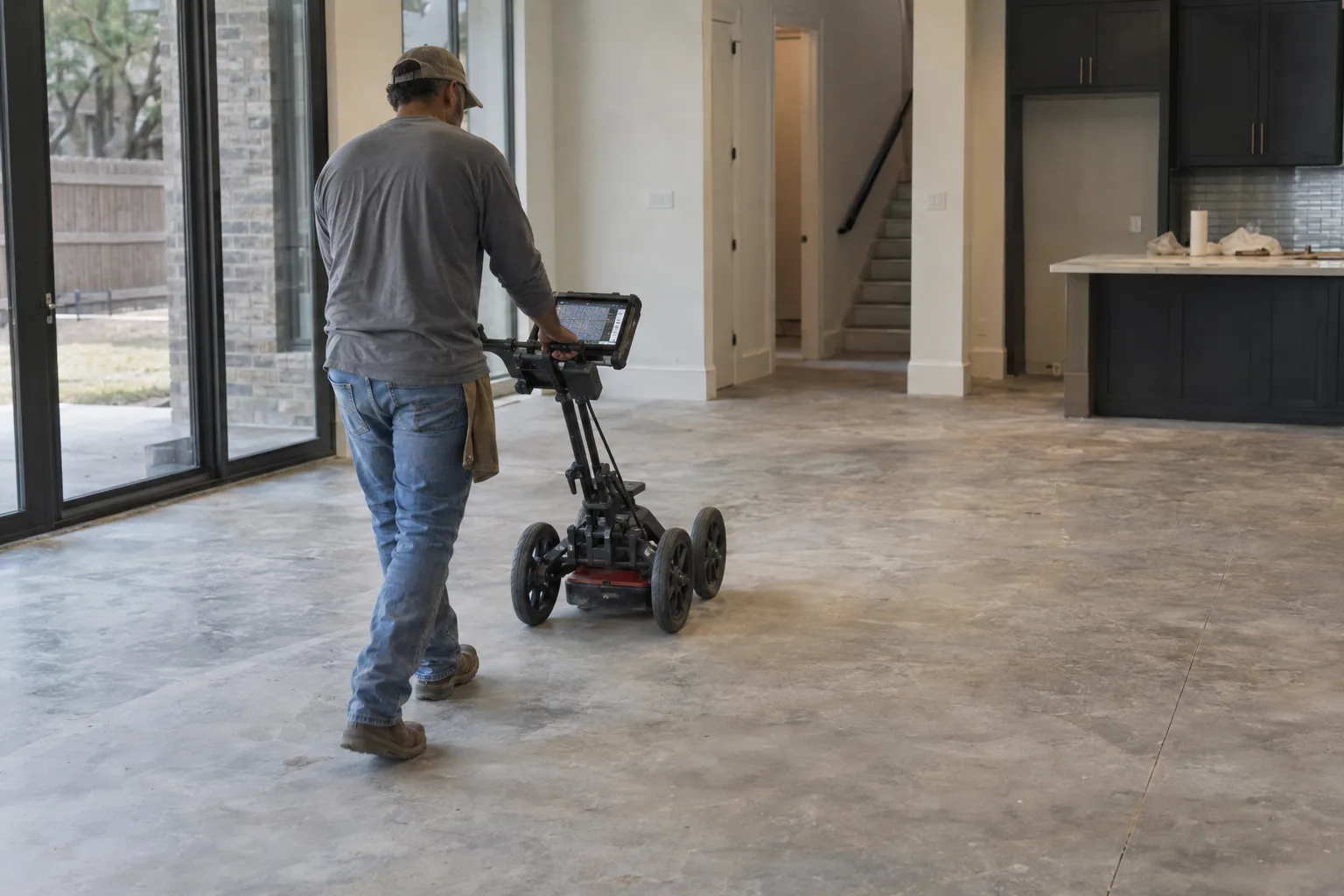
On one job in Garland, the slab edge on the south side showed a pocket blowout - a chunk of concrete ejected outward when a corroded anchor head finally let go. That was the obvious damage. When we ran Ground Penetrating Radar (GPR) - a scanning technology that maps cable positions within the concrete before any cutting or drilling begins - we found two adjacent cables showing irregular path deviation consistent with prior movement stress. Neither had broken. Both were candidates for re-stressing rather than replacement.
That GPR pass changed the entire scope. Without it, we would have repaired the broken anchor and left the adjacent cables unexamined. Those cables would have been the next call.
Full-slab orientation is the step that separates an accurate repair scope from a reactive one. It adds time to the assessment. It prevents the repair from inadvertently stressing cables that are already weakened. And it's the reason a written scope - not a verbal estimate - is the only honest way to present the work.
The Garland slab got three items addressed in one mobilization: anchor head replacement, pocket restoration on the failed section, and re-stressing on two adjacent tendons. One visit. One scope. No surprises on the follow-up call.
That's what a full-slab assessment is for.
Why Specialists Outperform General Foundation Contractors Here
Post-tension cable repair is not a category of foundation repair - it is a separate technical discipline.
Foundation repair in DFW typically means installing piers, lifting settled sections, or stabilizing movement through soil-level interventions. Those are real services. They address different problems with different tools.
PT cable repair works inside the concrete itself. It requires knowledge of tendon geometry, tensioning force specifications, anchor hardware compatibility, and GPR interpretation. It also requires understanding how concrete restoration at the repair site must be sequenced so the patch doesn't interfere with future cable access if that ever becomes necessary.
Here's how we handle the credential question directly: we work from PTI DC80.3 - the Post-Tensioning Institute specification for unbonded single-strand tendons - as our repair standard. That document defines the material, anchoring, and stressing requirements that a properly executed repair must meet. We reference ACI 318 and ACI 423 standards when coordinating with structural engineers on jobs that require a licensed PE to review the scope.
Knowing which standard applies - and when an engineer's review is required versus recommended - is knowledge that only comes from working exclusively in this space.
We do not subcontract PT cable work to generalists. Every post tension cable repair DFW job this team takes is handled by people who work in this specialty and nothing else.
The Complete Repair Sequence - Assessment Through Concrete Restoration
Every PT cable repair follows the same sequence - assessment, intervention, verification, restoration.
Here's what that looks like in practice:
- Full-slab GPR scanbefore any marking or cutting begins - cable positions confirmed, not assumed
- Failure classificationmid-span break, anchor-end failure, corrosion-driven wire loss, or tension loss without visible fracture
- Repair method selectionsplice, re-anchor, re-stress, or replacement, based on failure type and cable condition
- Tensioning verificationpost-repair confirmation that the restored cable is at or within design tension specification
- Concrete restorationspall repair, pocket filling, grout application at anchor pockets, and slab edge finishing
- Written documentationbefore and after photography, failure classification notes, and repair method record provided at job close
Replacement material for any new strand meets ASTM A416 - the standard specification for post-tension steel strand. We do not substitute lower-grade material on cost grounds.
Three coats of pocket grout on exposed anchor pockets. Not two. The DFW climate exposure profile calls for it.
Cable-by-Cable: How Every Repair Job Gets Completed
Every cable is assessed independently before the repair sequence begins.
Diagnostics
The first step on every job is location confirmation. GPR scanning maps cable paths before any saw cutting or core drilling occurs. This protects adjacent cables from accidental damage during repair access. It also reveals deviation patterns - cables that have shifted inside the slab are flagged for closer inspection during the repair window.
Failure type determines everything that follows. Mid-span failure - a break that occurs somewhere between the two anchor ends - requires different access geometry than an anchor-end failure, where the hardware at the slab edge has corroded or pulled through. We classify before we cut.
Implementation
Access to a mid-span failure means opening the slab surface above the break point. Anchor-end failures are accessed from the slab edge, leaving the floor surface undisturbed. That distinction matters for homeowners who have finished flooring - most repairs on anchor-end failures don't require disturbing interior surfaces at all.
Tensioning is applied with calibrated equipment to the specification required by the original slab design. We do not estimate tension by feel or by visual pull. Load is confirmed by measurement.
Post-Service Testing and Restoration
After tensioning, the cable path is re-scanned to confirm position integrity. Concrete restoration follows immediately - spalling is addressed, pockets are grouted, and slab edge surfaces are patched and finished. The job is not complete until the restoration work is done.
Documentation is assembled at close: failure classification, repair method, tensioning record, and photo set. That file is yours to keep - for insurance, for future inspections, and for real estate disclosure if that becomes relevant.
Post tension slab repair in Dallas gets done once, with documentation that proves it.
Dallas Communities We Serve Directly - No Subcontracting
We cover the full DFW metro - the same team handles jobs from Addison to DeSoto.
We serve Dallas, Irving, Garland, Mesquite, Richardson, Carrollton, Farmers Branch, Addison, University Park, Highland Park, Duncanville, DeSoto, Cedar Hill, Balch Springs, Rowlett, and Grand Prairie directly. The same team. No distance-based routing to outside crews.
Need PT cable repair DFW coverage beyond central Dallas? We also serve Fort Worth, Arlington, Plano, Frisco, McKinney, Denton, Allen, Lewisville, and surrounding communities across the metro.
Start With an Assessment - Here's How to Reach Us
A written repair scope starts with a conversation about what your slab is showing.
Tell us your address, what you're seeing, and whether you have any inspection reports or engineer findings already in hand. We'll review the situation and respond with next steps.
Email us at info@posttensioncablerepair.com to get started. Written repair scopes provided before any work begins - no verbal estimates, no surprise scope changes on arrival.