# Emergency PT Cable Repair - DFW Response When You Can't Wait Triage guidance starts on the first call - before anyone arrives on-site.
Is Your Home Safe Right Now? Here's What the Damage Actually Means
A single broken post-tension cable is serious - but it rarely means immediate structural collapse.
The goal of this page is simple. Get you calm, get you informed, and get a knowledgeable team moving toward your property fast.
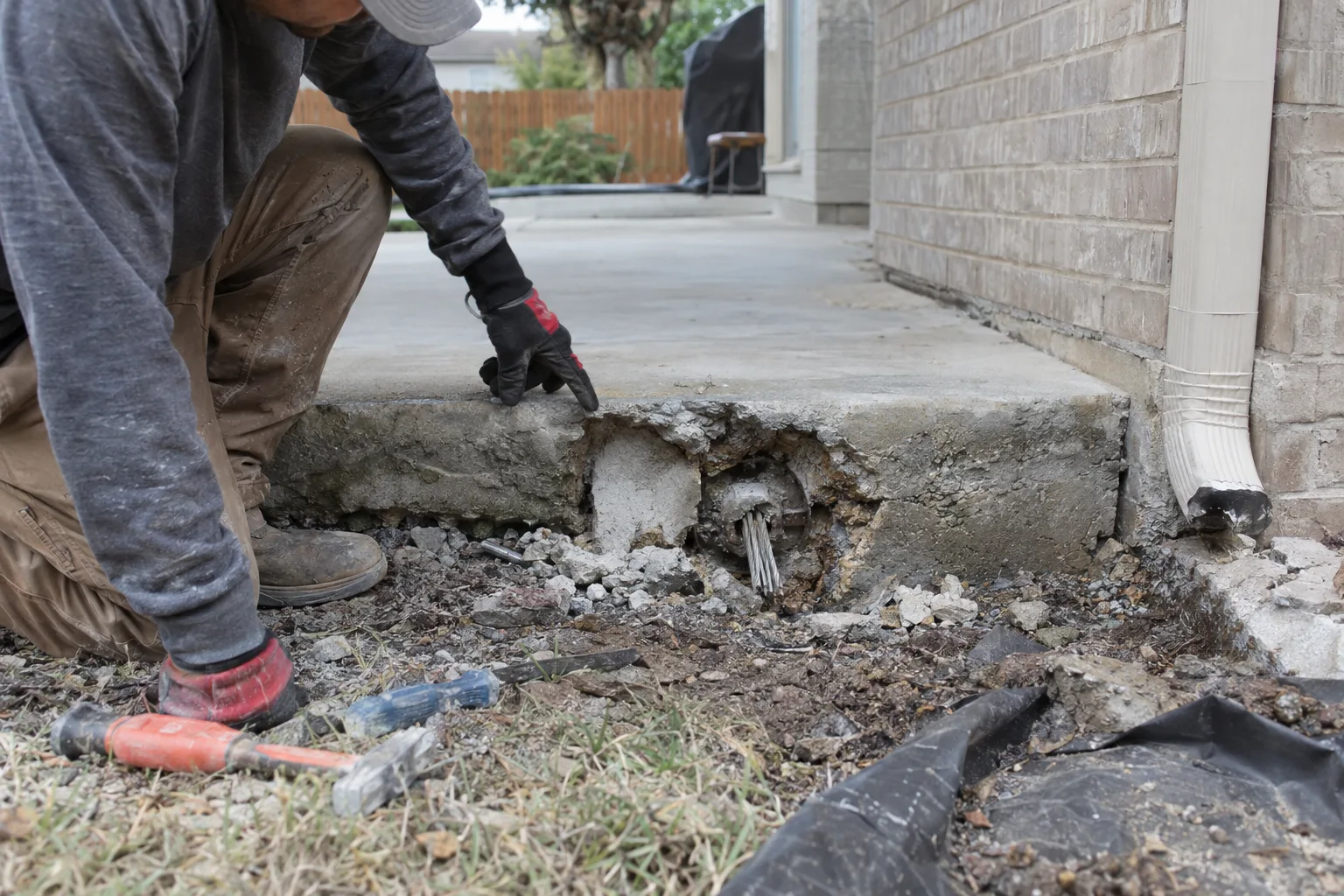
Emergency post-tension cable repair means same-day or next-day response for cable failures that pose immediate or escalating structural risk. That includes cables snapped under tension, cables severed during renovation or plumbing work, and slab blowout events where concrete has been physically ejected from the slab edge.
Call us. Triage begins on that first conversation - before anyone sets foot on your property.
Why Emergency Cable Failures Happen More Often in the DFW Metro
DFW sees more PT cable emergencies than most metros - and the clay soil is the reason.
The Dallas-Fort Worth area sits on Blackland Prairie soil - a highly expansive Montmorillonite clay that shrinks severely during dry stretches and swells aggressively when rain returns. That cyclical movement loads your post-tension cables beyond what designers in other regions typically engineer for. It's not a flaw in your slab. It's a local condition that accelerates stress on every PT system in the region.
Add to that the DFW renovation boom. Plumbers, electricians, and remodeling contractors regularly need to drill through or excavate near slabs. When a contractor hits a cable - which happens frequently in high-activity corridors like Frisco, Plano, inner Dallas, and Garland - that's an emergency with a contractor on-site, a project stopped, and a homeowner waiting for answers.
Emergency cable failures also spike after hard freeze events, like the February 2021 freeze that exposed pre-existing vulnerabilities across thousands of DFW slabs. Drought-breaking rain events have the same effect. The Dallas-Fort Worth climate creates conditions where "sudden" failures are often the final step in a longer stress cycle.
Mid-Renovation, Contractor Stopped - What Happened and What Comes Next
When a plumber stops mid-job and says "I think I hit something," that's the beginning of an emergency PT cable repair call.
I've taken this exact call more times than I can count across the DFW metro. The homeowner is usually in another room. The plumber is standing over a slab penetration - a core drill or saw cut made to access a drain line - and there's concrete debris on the floor that shouldn't be there.
What happened is a tension release. That's the sudden loss of stored tensile force when a PT cable severs. It's a physically energetic event. It can displace concrete, create a cable blowout - which is when the severed cable drives force outward through the slab edge pocket, ejecting a chunk of concrete - and in some cases disturb adjacent cables.
Here's what I tell every caller in that moment: stop all work near that area. Don't attempt to remove concrete debris or pull anything from the opening. Take photographs of exactly what you see, with a timestamp if your phone allows it. That emergency documentation - the photos, the contractor's account, the timeline - becomes essential for insurance and contractor liability determinations later.
Then I get a team moving toward the site.
The active renovation scenario - a cable failure during an ongoing project - is actually one of the more manageable emergency types when triage happens fast. The contractor is present. The failure point is visible. We know exactly what caused it. The repair path is clear.
What makes it worse is delay. A day without proper documentation. A contractor who patches concrete over the damage before it's assessed. Those situations cost the homeowner leverage. Early response protects options.
Across the DFW metro, from active build-out corridors in McKinney and Prosper to older neighborhoods in Mesquite and Irving, that call gets prioritized. This is exactly the scenario this business was built to handle.
Calm Answers Under Pressure - What to Expect When You Call
Every emergency call gets triage guidance immediately - not a voicemail and a callback promise.
When you call during an active emergency, the first thing you'll get is specific, plain-language guidance on what to do right now. What to stop. What to leave in place. What to photograph. That structural triage - the initial assessment of whether a cable failure poses an immediate life-safety concern or is a serious-but-stable situation - begins on the phone.
Most single-cable failures are serious-but-stable. That doesn't mean you wait weeks. It means you have time to do the documentation correctly, make a smart call on the repair path, and avoid reactive decisions that complicate the job.
If the situation warrants same-day response, that's what happens. Emergency calls from the DFW metro - including outlying areas like Weatherford, Rockwall, and Waxahachie - are routed for fastest possible response, not held in a standard scheduling queue.
Our Emergency Response Protocol From First Contact to On-Site Arrival
Every step of our emergency process is designed to reduce confusion and move fast.
- First call triage:Plain-language safety assessment, immediate guidance on site actions, documentation instructions
- Response routing:Emergency location prioritized across the DFW metro footprint - from Dallas core to outlying service areas
- On-site assessment:Structural evaluation of the failure zone, adjacent cable condition check, slab edge inspection
- Emergency documentation:Photographs, written condition notes, timestamped records for insurance and liability files
- Material readiness:Emergency repairs use PTI-specification materials - including ASTM A416-grade steel strand for replacement work - not whatever's available on a truck
- Coordination:If a licensed structural engineer review is required by jurisdiction or project scope, we facilitate that connection - it's not left to the homeowner to figure out alone
Step-by-Step - From the Moment You Call Through Repair Completion
Every emergency repair follows a defined response protocol - from first contact to final verification.
Diagnostics
The on-site assessment begins at the failure point. We check the severed or damaged cable, evaluate the anchor hardware at both the live end and dead end, and inspect the surrounding slab for secondary damage. If a cable blowout has occurred - concrete ejected at the slab edge - we document the pocket condition before any concrete is disturbed. Where slab penetration by a contractor caused the failure, we capture the full scope of the cut before the site is altered.
Implementation
Repair approach is determined by what the diagnostics show. A cleanly cut cable in an accessible location has a different repair path than a corroded cable that snapped under load at a concealed pocket. We use proper tension-release and re-stressing procedures - not patched approximations. Pocket cover restoration, proper grout fill, and slab edge repair are completed as part of the same job, not left as separate follow-up items.
Post-Service Testing and Documentation
Before the job is closed, the repair is verified. Tension levels are checked. The repaired area is photographed in final condition. A written record of the work completed is provided. That documentation supports insurance claims, satisfies lender requirements, and gives any future inspector a clear account of what was done and when.
Emergency Coverage Across Dallas, Fort Worth, and Surrounding Communities
We respond to emergency PT cable calls across the full DFW metro and surrounding region.
Service areas include Dallas, Fort Worth, Arlington, Plano, Irving, Garland, Frisco, McKinney, Denton, Lewisville, Rockwall, Mesquite, Grand Prairie, Carrollton, Richardson, and Flower Mound. We also cover outlying communities including Weatherford, Waxahachie, Cleburne, Sherman, Greenville, Waco, and Tyler. If you're in the DFW region and you have a PT cable emergency, call us.
Call Now - Triage Begins Immediately
An emergency post-tension cable repair call in Dallas-Fort Worth gets answered, not queued.
Don't wait for the situation to get clearer on its own. The first call gets you triage guidance, documentation direction, and a response timeline. Whether the cable snapped, was cut during renovation, or showed up as a blowout, the repair path starts the moment you reach us.
Contact Post Tension Cable Repair at info@posttensioncablerepair.com or use the form on this page. Tell us what happened and where you are. We move from there.