Tarrant County properties scheduled and dispatched without added lead time or distance fees.
What Fort Worth Homeowners Need to Know About Their Post-Tension Slab
Most Fort Worth homes built after 1970 sit on a post-tension slab - a concrete foundation reinforced with steel cables under tension.
Here's what most homeowners don't realize about post-tension slabs: the cables do most of their work invisibly. You won't see them. But when one fails - whether from corrosion, an accidental cut during plumbing work, or decades of soil movement - the signs show up at baseboards, door frames, and along the slab perimeter.
Fort Worth's housing stock is full of these systems. Knowing you have one is step one. Knowing who to call when something goes wrong is step two.
Near Southside, Wedgwood, Ridglea - Where 1970s and 1980s PT Slabs Are Aging Out
Fort Worth's established neighborhoods are home to some of the oldest post-tension slabs in the DFW region.
The Near Southside, Wedgwood, and Ridglea areas developed heavily during the 1970s and 1980s - the same era when unbonded single-strand tendons became the dominant foundation system in Texas residential construction. An unbonded single-strand tendon is a steel cable coated in grease and wrapped in plastic sheathing, embedded in concrete and tensioned after the pour.
Those slabs are now 35 to 50 years old. The cables were designed for a service life of 30 to 50 years under ideal conditions. Tarrant County soil moisture cycling - the repeated expansion and contraction of local clay soils driven by DFW's drought-and-rain cycles - puts slabs under stress that shortens that timeline.
Inspection reports from Fort Worth's older neighborhoods increasingly flag open grout pockets, corroded anchor hardware, and cables that have already lost tension. This is not a future problem for these areas. It's a present one.
What Shows Up When We Walk a Fort Worth Slab Built Before 1990
Older Tarrant County slabs have a specific set of failure patterns - and they tell a clear story once you know what to look for.
One of the more instructive jobs I've walked was in the Wedgwood area - a single-story home built in 1978. The homeowner had noticed a crack running diagonally from a doorway corner toward the exterior wall. A plumber had already been out and confirmed the drain lines were intact. The assumption was foundation settlement, and the homeowner had already called two foundation companies.
Neither one had looked at the slab edge.
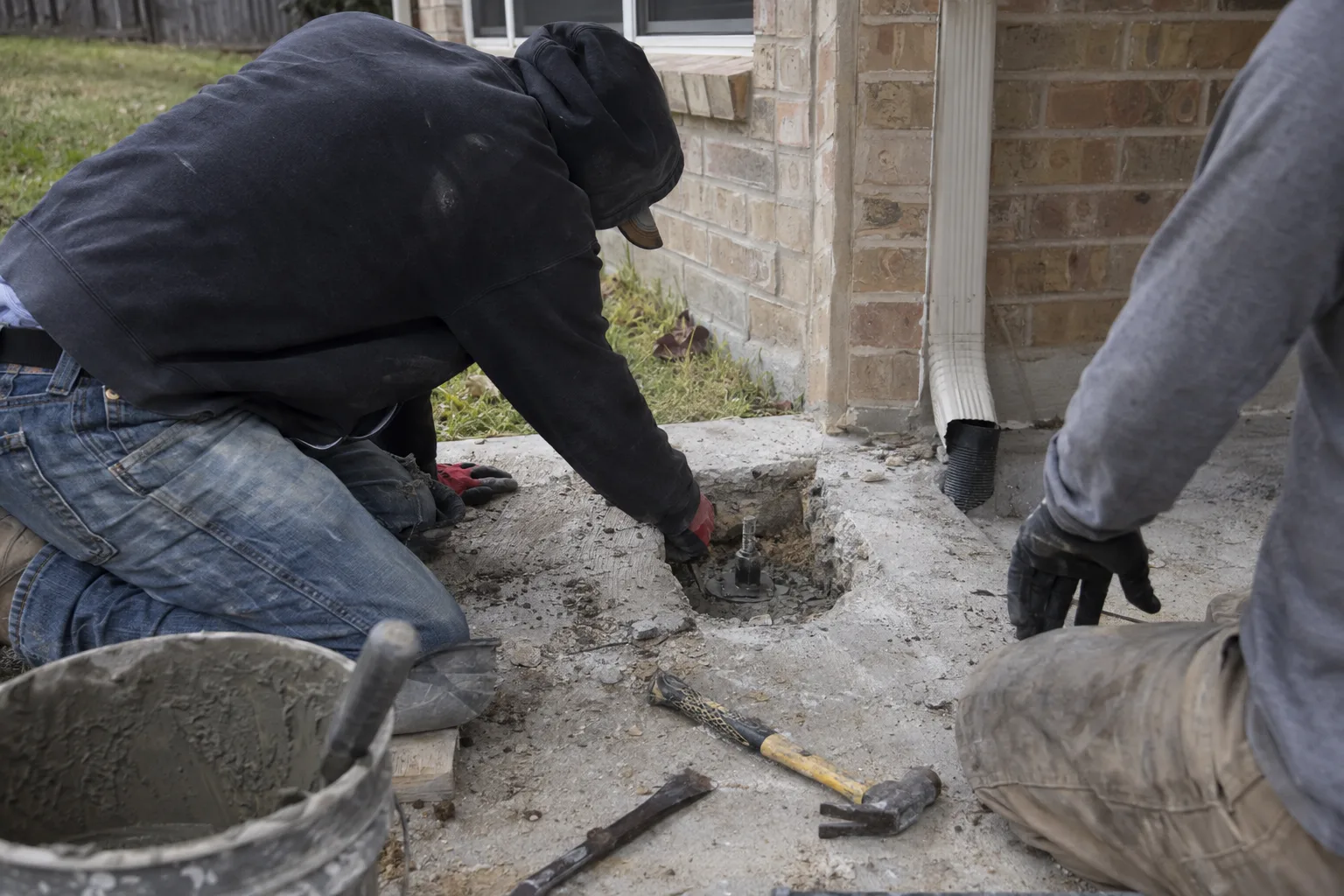
When we walked the perimeter, the story became obvious. Three grout pockets along the south-facing edge were open to the weather. One had been open long enough that the pocket walls had stained brown. The anchor hardware on two of those pockets showed visible corrosion. And one cable - when we tested tension - had lost load-bearing capacity entirely.
Here's the detail that matters for Fort Worth specifically: south-facing slab edges in this climate take more heat and more drying stress than any other side of the structure. When the original pocket grouting was inadequate - which was common on 1970s and 1980s construction - moisture gets in, corrosion starts, and the anchor end degrades quietly for years before anyone notices.
Differential settlement - uneven vertical movement of different slab sections caused by soil expansion and contraction - was happening here not because of a pier problem but because one cable had stopped doing its job. The fix wasn't piers. It was post-tension cable repair and pocket restoration.
The homeowner had almost paid for the wrong service entirely.
Fort Worth Building Era Context - the specific construction methods, materials, and inspection oversights common to Tarrant County homes built during the 1970s and 1980s PT boom - shapes how we approach every job in this part of the metro.
Fort Worth Is a Primary Market - Not a Drive-Out Exception
We dispatch to Tarrant County on the same schedule as any Dallas-area job - same crew, same documentation, same response standard.
Some specialty services operate with a geographic core and treat outlying areas as overflow. Fort Worth is not overflow for us. It is a primary market. That means your assessment gets scheduled without extra lead time. Your repair crew arrives fully equipped. Your documentation package is identical to what any Dallas homeowner receives.
Tarrant County soil moisture cycling creates the same PT failure patterns as the Blackland Prairie clay across the rest of the DFW region. The repair work is the same. The crew deployment is the same. The only thing that differs is the zip code.
If you're in Fort Worth and you've been told you have a broken or underperforming post-tension cable, you don't need to search for someone closer. We're already here.
How Every Tarrant County Repair Gets Assessed, Permitted Where Required, and Documented
Every Fort Worth job follows a defined quality standard - from the first site visit to the final documentation package.
Our process on every Tarrant County repair:
- Slab edge inspectionto identify open pockets, corroded anchors, and visible cable exposure before any work begins
- Tension verificationon suspect cables using calibrated equipment - not visual guesswork
- Permit coordinationwhen Fort Worth or surrounding municipal codes require structural concrete repair permits (requirements vary by scope and jurisdiction)
- PTI DC80.3-referenced repair methodsfor unbonded single-strand tendons - the Post-Tensioning Institute specification that governs this work
- ASTM A416-compliant replacement strandwhen a cable requires full replacement rather than repair
- Pocket restorationwith material matched to the original pocket depth and slab edge profile
- Written documentationprovided at job completion - including pre-repair photos, cable condition notes, and repair scope summary
Three coats of pocket sealant. Not two. That detail matters in a climate with Tarrant County's temperature swings.
From Your First Call to a Finished Slab - The Fort Worth Repair Sequence
The repair process follows a defined sequence designed to protect your slab, your home, and your documentation record.
Diagnostics
Your first contact triggers a site assessment. We review your inspection report if one exists, then walk the slab perimeter and interior to identify cable locations, pocket conditions, and tension status. For slabs where drilling or core work is needed nearby, we coordinate GPR scanning - ground-penetrating radar that maps cable positions before any slab penetration occurs.
If you've had a plumber, HVAC tech, or renovation crew working recently, we pay particular attention to any area where drilling happened. Accidentally cut cables during renovation work are extremely common in Fort Worth's active remodel market, and they don't always make a noise you'd recognize.
Implementation
Repair work is scoped after diagnostics - not before. That means you receive an accurate, site-specific scope rather than a generic estimate. Cable repairs involve accessing the anchor end, addressing the failed component, restoring tension where appropriate, and sealing the pocket correctly. Full cable replacement follows a similar process with new ASTM A416-grade strand.
We work with minimal disruption to occupied homes. Most repairs do not require you to vacate.
Post-Service Testing and Documentation
After repair, we verify tension on the repaired cable and inspect adjacent cables for secondary concerns. You receive a written documentation package that includes repair scope, material specifications, photos, and any engineer coordination notes. That package matters - for insurance, for lenders, and for future buyers.
Fort Worth Communities We Serve - Including Weatherford, Cleburne, and the Chisholm Trail Corridor
We serve Fort Worth and the surrounding Tarrant County region with no geographic service tiers.
Our Fort Worth service area includes the Near Southside, Wedgwood, Ridglea, Westover Hills, and Arlington Heights neighborhoods. We also serve communities along the Chisholm Trail Parkway corridor, including Burleson and Crowley. Outlying areas including Weatherford, Cleburne, Mansfield, Euless, Bedford, Hurst, Colleyville, Southlake, and Grapevine are all within our standard service footprint.
Schedule Your Fort Worth Assessment Today
A post-tension cable issue in Fort Worth gets the same priority and the same team as any job in Dallas.
If an inspection report flagged a cable problem, or if you're seeing cracks and uneven floors in a home built before 1990, reach out now. Email us at info@posttensioncablerepair.com with your address and a brief description of what you've noticed. We'll confirm scope and get your Tarrant County assessment scheduled without delay.