Post-tension cables (high-strength steel strands embedded in a concrete slab and stressed after the concrete cures) fail in specific, recognizable ways. Knowing which symptoms are cable-related - versus soil movement or shrinkage cracking - changes everything about the repair decision. This page maps each visible sign to the failure mechanism behind it.
How to Tell Whether What You're Seeing Is a PT Cable Problem or Something Else
Not every foundation symptom points to a post-tension cable - but some symptoms almost always do.
Older Oak Cliff, Garland, and Prosper - Why Symptom Patterns Differ Across the Metro
Where your home sits in the DFW metro shapes which symptoms you'll see first.
A 1978 home in Oak Cliff sits on Blackland Prairie clay - Montmorillonite clay that expands aggressively when wet and shrinks hard during drought. Its PT cables have cycled through forty-plus years of that soil movement. Symptoms there tend to show up at anchor zones and slab edges.
A 2015 build in Prosper sits on similar soil but with far fewer cycles behind it. When symptoms appear early in that environment, it usually signals a construction-era issue - inadequate concrete cover, an improperly grouted pocket (the small recessed void at the slab edge that protects anchor hardware), or a subgrade prep problem.
Garland homes from the 1980s and 1990s sit squarely in the highest-risk demographic: old enough for cable corrosion to be active, but rarely old enough for owners to expect it. Reading symptom patterns through that lens matters. Generic foundation advice misses it entirely.
A Chunk of Concrete Missing From the Slab Edge - What That Means and What to Do Next
A slab edge blowout is one of the clearest signs a PT cable has already snapped.
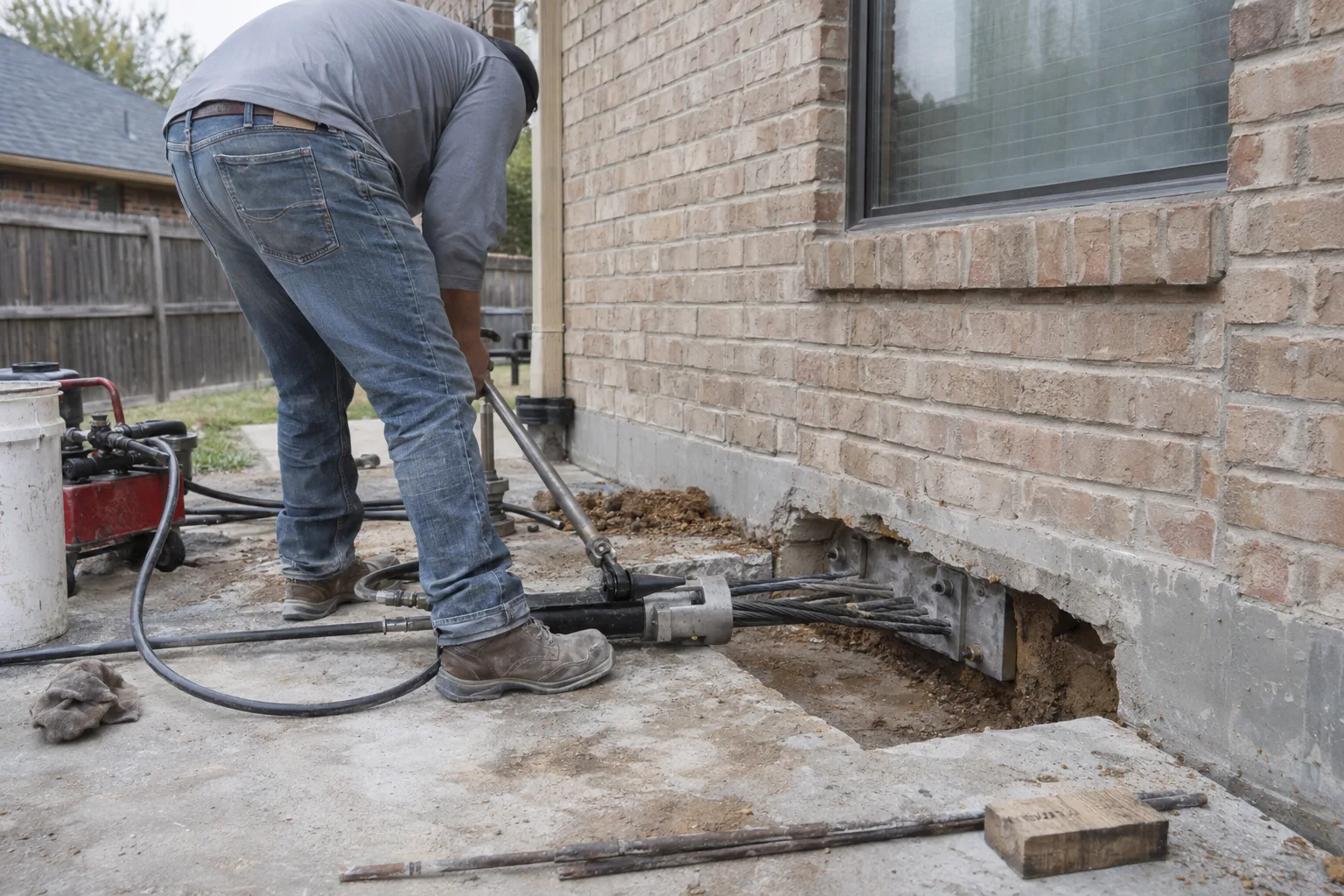
A slab edge blowout - when a cable snaps under tension and ejects a chunk of concrete from the perimeter of the slab - is dramatic when it happens. Sometimes you hear it. More often, a homeowner just finds the missing piece near the garage apron or along the patio edge and assumes it chipped off during yard work.
Here's what I see on assessments: the ejection pattern is distinct. The concrete breaks outward in a roughly triangular shape, centered near the anchor hardware location. The exposed interior shows a frayed or absent cable tail. That's not random weathering. That's a cable that released its stored tension in one event.
[Note to client: Insert name of lead inspector or owner here for first-person attribution - intake did not provide a named individual.]
That said, a blowout is just one of seven symptoms worth knowing. The others are subtler. Some take months to notice. Some only appear inside the house.
Seven symptoms that suggest PT cable involvement:
1. Slab Edge Blowout or Missing Concrete
Concrete ejected from the slab perimeter, often near where grout pockets (the protective concrete fill over anchor hardware) are located. Almost always cable-related when accompanied by a visible metal tail or cavity.
2. Longitudinal Cracking Along the Floor
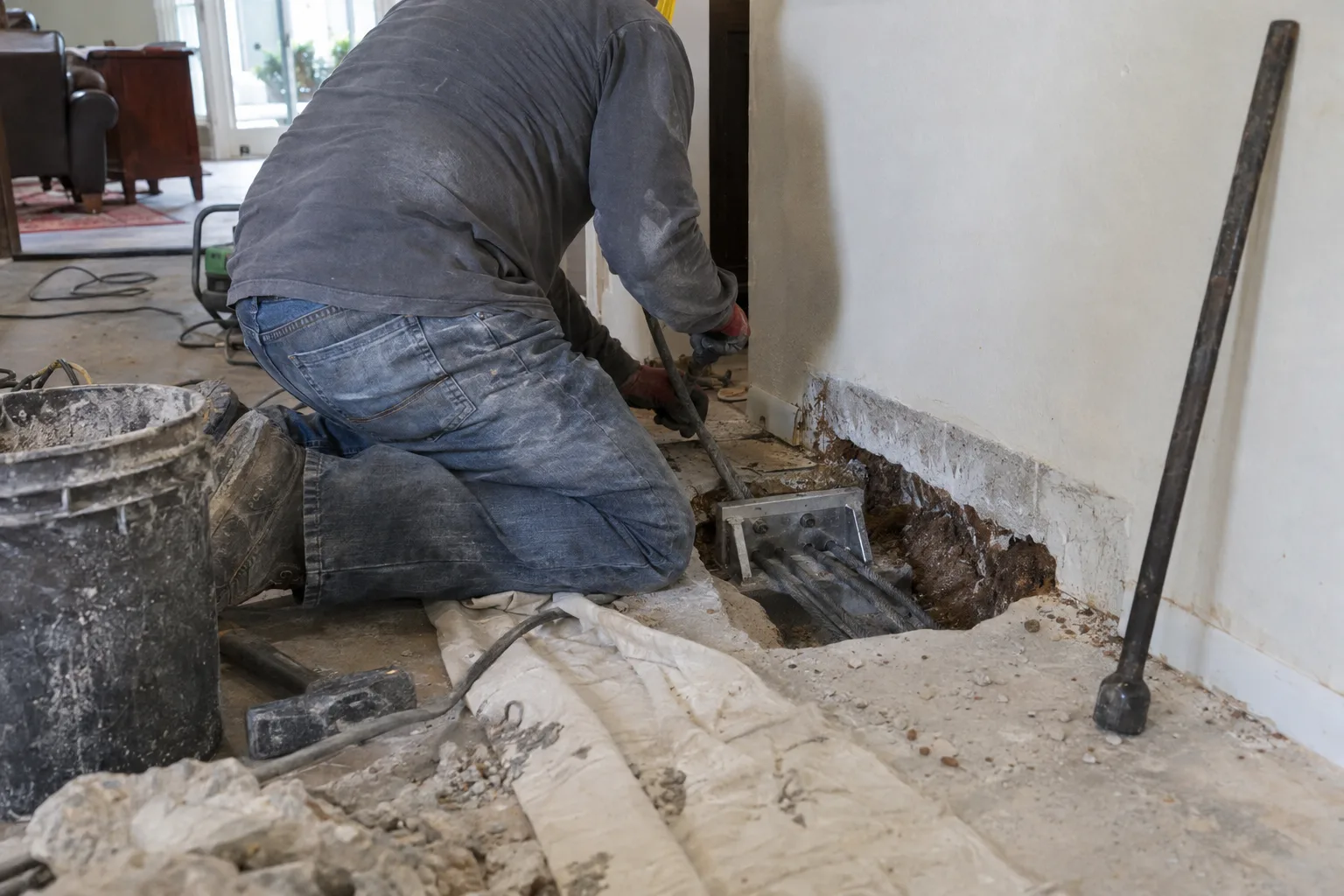
A crack running parallel to the direction the cables travel - not diagonal, not at a corner. Longitudinal cracking (a crack that follows the cable path rather than crossing it) concentrates stress from a cable that's lost tension. On DFW slabs, these often appear in hallways or through the middle of a great room.
3. Door Frame Racking
When a door frame shifts out of square due to slab movement - causing doors to stick, drag, or fail to latch - it indicates differential settlement (uneven sinking or movement of one slab section relative to another). PT cable failure can contribute to this, especially when cables on one side of the home are still holding tension and the other side isn't.
4. Stair-Step Cracking at Interior Corners
Diagonal cracking that climbs from a floor corner toward the ceiling. This is classic differential settlement behavior. Soil-only movement can cause it. So can a failed cable zone. The distinction matters for choosing the right repair path.
5. Grout Pocket Deterioration at the Slab Edge
Crumbling, missing, or hollow-sounding fill at the small rectangular recesses along the slab perimeter. Grout pocket deterioration exposes anchor hardware to moisture - which starts corrosion on the cable's anchoring components. This symptom shows up before cable failure, not after.
6. Concrete Spalling Near the Anchor Zone
Concrete spalling near anchor zones (flaking or surface breakdown at the slab edge near hardware locations) signals active moisture infiltration. When you see it at multiple locations around the perimeter, corrosion is likely already underway inside the slab.
7. Tension Loss Indicators - Hairline Cracking in a Grid Pattern
Fine hairline cracks distributed in a regular grid across the floor - not random, not corner-driven - can indicate tension loss indicators: observable changes suggesting cables have lost prestress load without fully snapping. This is the hardest symptom to self-diagnose. It looks like normal concrete aging. The grid pattern and spacing are what distinguish it.
Knowing What You're Looking At Puts You Ahead of the Problem
Identifying the right symptom early gives you more options - not fewer.
Here's what most homeowners don't realize about PT cable symptoms: a cable showing tension loss indicators or grout pocket deterioration is still reachable with a less invasive repair approach. A cable that has fully snapped and produced a blowout may need more extensive access - but it's still a known, manageable scope.
The anxiety usually comes from not knowing what category the problem falls into. That changes on a proper assessment. Symptoms get matched to mechanisms. The repair scope becomes specific rather than theoretical. Knowing exactly what's happening inside your slab is not a reason to panic - it's the information that makes a confident decision possible.
How We Confirm a Symptom Is PT-Related Before Any Repair Scope Is Written
Every symptom gets mapped to the cable system before any scope is written.
Our confirmation process covers these checkpoints before anything else:
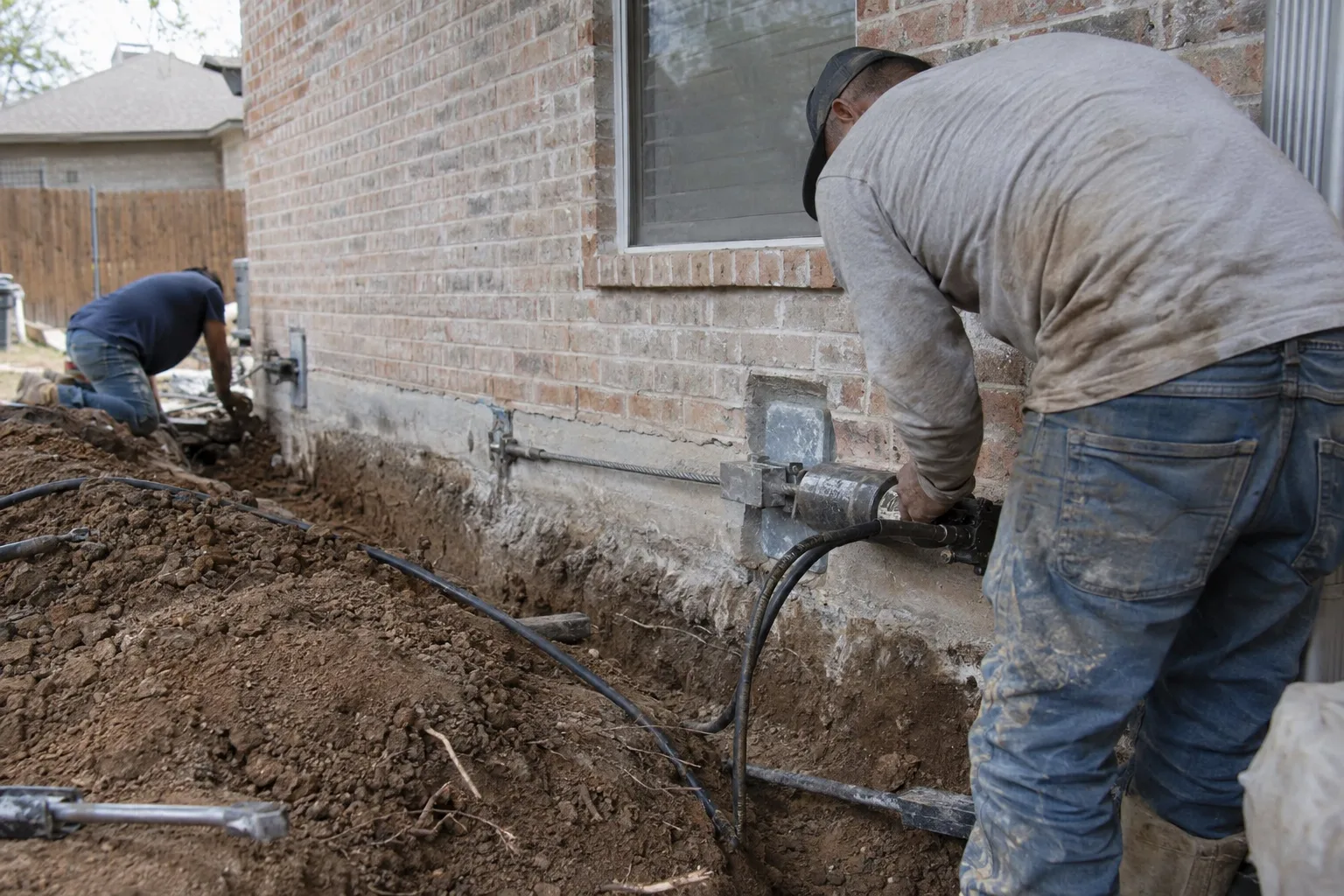
- Perimeter walk: Every grout pocket and anchor zone inspected for spalling, deterioration, and blowout evidence
- Floor pattern mapping: Crack orientation and distribution documented - longitudinal versus diagonal versus grid pattern
- GPR coordination: When interior symptoms suggest tension loss without a visible blowout, ground penetrating radar locates cable paths and identifies anomalies beneath the slab surface
- Door and frame check: Frame squareness measured at affected zones to quantify differential settlement, if present
- Soil context review: Slab age and neighborhood soil history factored into the symptom interpretation - a 1985 Garland home and a 2018 Frisco home are read differently
No repair scope is written until the symptom and the mechanism match. That's not a delay - that's how accurate repairs get built.
Soil Age, Slab Era, and Construction Type - Why the Same Symptom Has Different Causes
The same visible crack can have different causes depending on when and where your home was built.
Three variables shape what a symptom actually means in DFW:
Soil cycle history. Blackland Prairie clay in central Dallas has been through the 2011 drought, the 2021 freeze, and multiple wet-dry cycles before that. Cables installed in the 1980s have absorbed that movement repeatedly. By contrast, suburban expansion zones in Celina or Prosper haven't yet seen a full decade of intense drought. Corrosion-driven failures dominate in older zones. Construction defects dominate in newer ones.
Slab era. PT cable standards evolved significantly between the 1970s and the 1990s. Older slabs used thinner concrete cover over cables - meaning moisture reached steel faster. Post-1990 construction generally used improved pocket and anchor specifications. The same symptom on a 1975 Oak Cliff slab and a 1995 Richardson slab represents different risk levels.
Construction type. Single-family residential PT slabs are predominantly unbonded single-strand tendons - meaning each cable is individually sheathed in plastic and can be replaced independently. That's a different repair equation than a bonded system. Knowing which system your home has determines whether a single snapped cable is a focused repair or part of a broader assessment.
These aren't details a generic inspection covers. They're the details that make a repair recommendation accurate.
Symptom Assessments Scheduled Across DFW - From Inner Dallas to Celina, Wylie, and Waxahachie
We assess PT cable symptoms throughout the full DFW metro and surrounding areas.
Service areas include Dallas, Garland, Irving, Mesquite, Grand Prairie, Richardson, Carrollton, and Farmers Branch. We also cover Plano, Frisco, McKinney, Allen, and Celina to the north. Fort Worth, Arlington, Mansfield, and Weatherford to the west. Rockwall, Wylie, Rowlett, Sachse, and Kaufman to the east. Waxahachie, Ennis, Corsicana, and Waco to the south.
Describe What You're Seeing - We'll Tell You Whether It Warrants an Inspection
Tell us the symptom. We'll tell you whether it points to a PT cable.
You don't need to diagnose your slab before you call. Describe what you're seeing - a crack pattern, a missing piece of concrete, a door that stopped closing. We'll ask the right questions and tell you honestly whether a PT cable assessment is the right next step. Contact us at info@posttensioncablerepair.com to get started.