CTR Subhead: Written repair record handed to you before the crew leaves the site.
What the Repair Actually Involves - From Locating the Cable to Closing the Concrete
Post-tension cable repair is a defined sequence, not a judgment call made on the fly.
It starts with confirming exactly where the cable runs. It ends with verified tension and a closed concrete surface. Between those two points are specific steps - in a specific order - that cannot be skipped or rearranged. That sequence is what separates a repair that holds from one that creates new problems down the road.
Here's what that sequence actually looks like.
Why DFW Homes Require GPR Confirmation Before Any Access Point Opens
In Dallas-Fort Worth, skipping GPR confirmation before opening a slab is not an option.
DFW homes built from the 1970s through today use unbonded single-strand tendons - single steel strands coated in grease and enclosed in a plastic sheath - running through the slab in a grid pattern. That grid is not always where the original plans say it is. Construction variances are common. On aging slabs in neighborhoods like Garland, Mesquite, and inner Dallas, the original layout documentation may not exist at all.
GPR scanning - Ground Penetrating Radar, a non-invasive imaging method that maps cable positions inside concrete without cutting - gives us a confirmed picture before any tool touches the slab. That picture protects the cables that are still healthy. It also defines the precise access point location, which keeps the opening as small as the repair actually requires.
Here's what most homeowners don't realize about DFW slabs: the clay soil movement that's so hard on post-tension cables also shifts cable positions slightly over decades. A scan from the original blueprint and a scan from today are not always the same map.
From the Moment We Arrive to the Moment We Hand You the Record
Every repair follows the same sequence - this is what that sequence looks like in practice.
A homeowner in Rockwall had contacted us after a home inspector flagged a cable issue during a pre-sale inspection. The report said "apparent post-tension cable failure at anchor end, east edge." She had agreed to sell the home and had a closing window. She needed the repair done and documented.
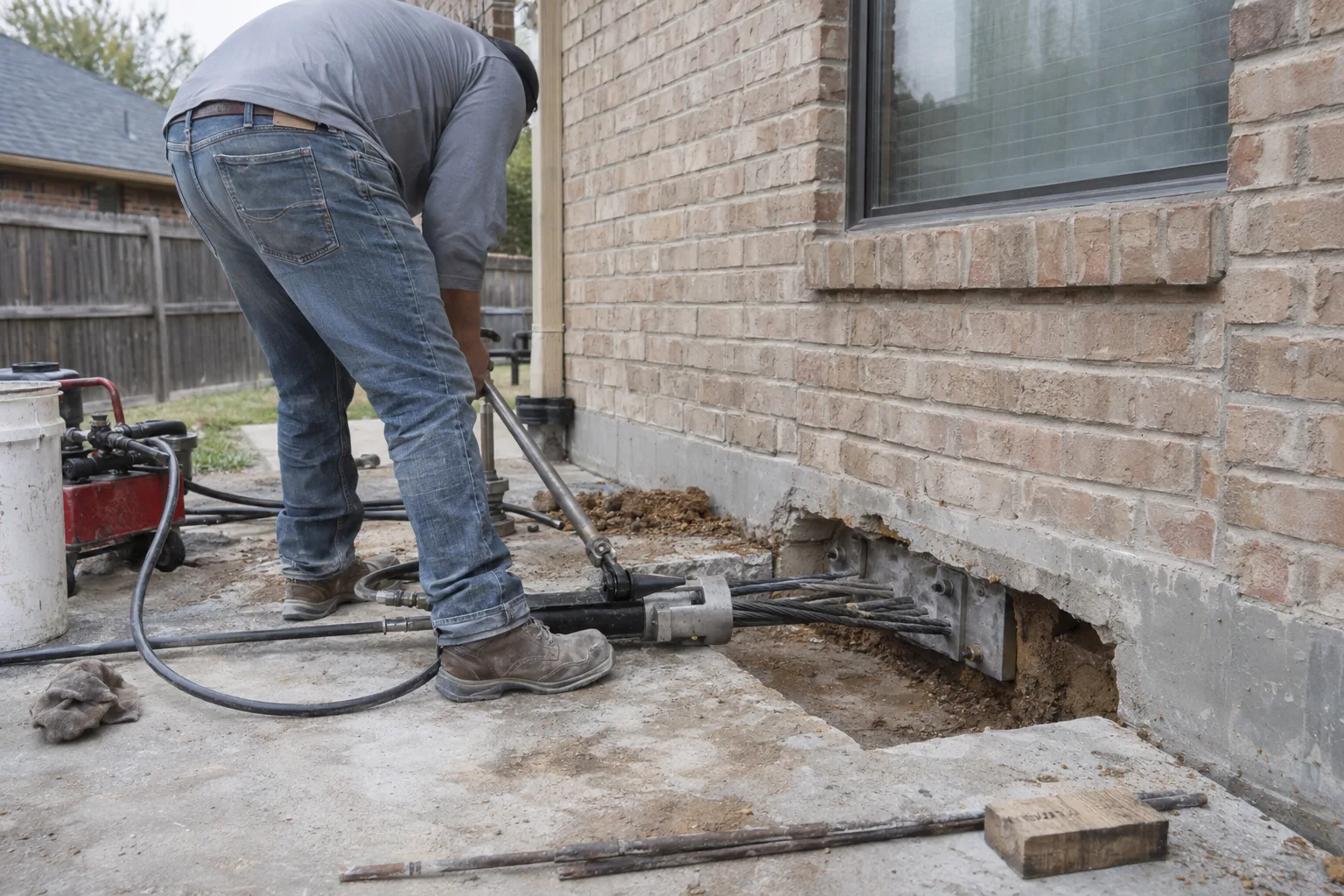
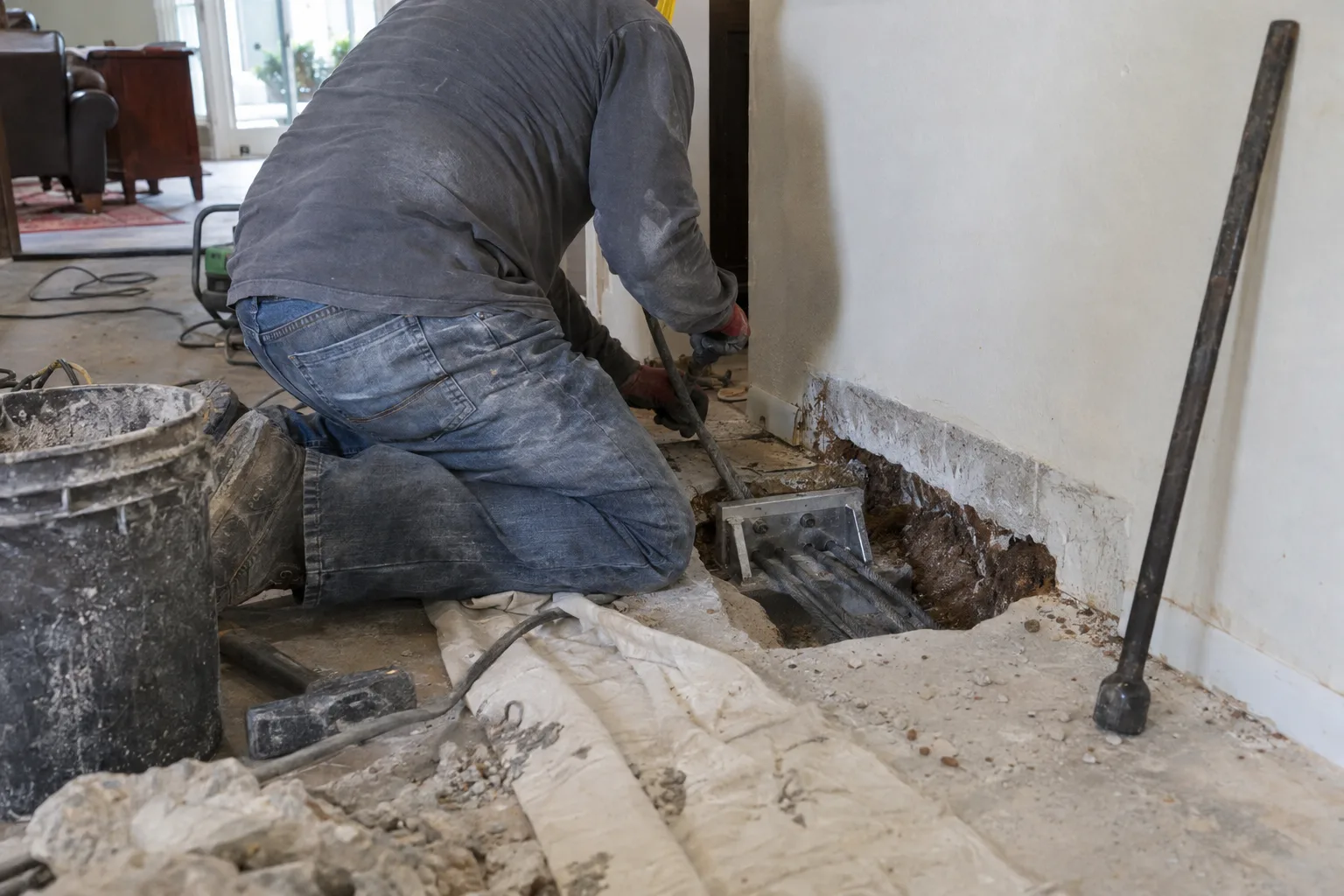
When we arrived, the first thing we did was run the GPR scan along the slab edge. The scan confirmed the anchor-end failure location and showed us three adjacent cables we needed to protect. Access point opening - the controlled removal of concrete above and adjacent to the failed anchor - came next. The access point size was determined by the failure type, not by guesswork. Anchor-end failures require edge access only. We didn't open anything we didn't need to.
Once the failed anchor hardware was exposed, we could see exactly what had happened. The anchor pocket had been improperly grouted at original construction. Water had reached the anchor over years, corrosion had progressed, and the anchor had failed to hold tension.
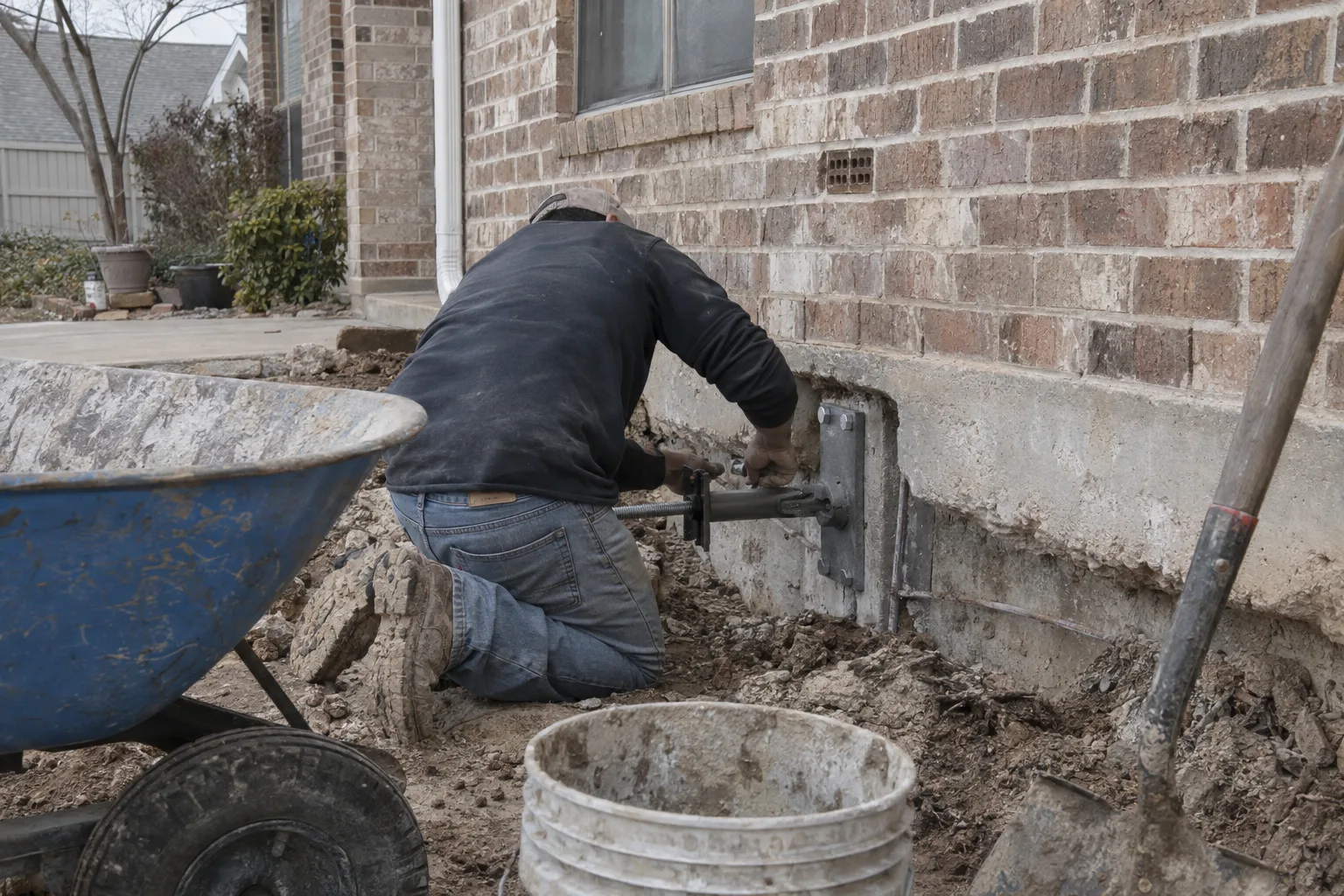
We replaced the anchor hardware, threaded the repaired section, and applied tension using a calibrated hydraulic jack - the stressing tool used to bring the cable back to its original design load. Tension verification came next. We confirmed the cable had reached and held the correct load before closing anything.
Concrete restoration - patching, curing, surface finishing - followed. Before we left, we produced the written repair record: what we found, what we replaced, what tension was applied, what materials were used. She had documentation in hand before closing day.
That sequence - scan, access, repair, tension, verify, restore, document - does not vary by job size or zip code.
Every Step Is Verified Before the Next One Begins - That's How the Sequence Works
Verification is built into the sequence - not added at the end.
Some repair work gets checked after everything is done. That approach creates a problem: if the tension wasn't right, the access point is already closed. With post-tension cable repair, verification happens at the step it belongs to.
Tension verification - confirming the cable has reached its design load using calibrated gauging equipment - happens before the access point is closed. Not after. That means if anything needs adjustment, we can still reach it.
The written repair record reflects what was actually verified, not what was intended. That distinction matters if you ever need to present documentation to an insurer, a lender, or a future buyer's inspector. What was verified and when - that's the record you're handing them.
GPR, Access, Repair, Tension Verification, Restoration - The Full Protocol in Order
The complete repair protocol runs five steps - in this order, every time.
- GPR Scanning: Cable positions confirmed via Ground Penetrating Radar before the slab is touched. Protects adjacent cables and defines the access point location.
- Access Point Opening: Controlled concrete removal sized to the failure type. Anchor-end failures open at the slab edge. Mid-span failures open from the slab top. Never larger than necessary.
- Repair or Replacement at the Failed Component: Anchor hardware, mid-span cable section, or pocket assembly - addressed at the specific component that failed, not the surrounding area.
- Hydraulic Jack Tensioning: Calibrated stressing jack applied to bring the cable to design load. Matched to the cable's original specification.
- Tension Verification, Concrete Restoration, and Written Record: Load confirmed, access point closed, surface finished, documentation produced. All three before the job is closed out.
Three coats of grout on a pocket repair. Not two. That's a standard, not a suggestion.
Anchor-End vs. Mid-Span - How Failure Location Changes What Repair Day Looks Like
Where a cable fails determines how the repair is accessed - and that changes everything about the day.
Anchor-end failures - the most common PT cable failure type in DFW's aging housing stock - occur at the live end or dead end hardware embedded in the slab edge. The cable didn't break in the middle. The anchor that holds the tension gave way. These failures require edge access: a portion of the slab perimeter is opened, the hardware is exposed and replaced, and tension is re-applied from the edge.
Mid-span failures are different. The cable itself fractured somewhere between the two anchor points. This requires opening the slab from the top, finding the break location using GPR, and either splicing or replacing the affected section depending on how much of the strand is compromised.
Each failure type has a different access footprint, a different material requirement, and a different timeline. An anchor-end repair on a residential slab is typically a one-day job. A mid-span failure with extensive corrosion may require engineering review before tensioning proceeds.
That distinction - anchor versus mid-span - is one of the first things confirmed during the GPR scan. It shapes everything that follows. Knowing it in advance means the right materials and tools arrive on the right day. No second trip because we underestimated scope.
This is especially relevant in DFW's older suburban neighborhoods - Garland, Irving, Grand Prairie - where 1980s-era PT slabs are now reaching the age where both failure types appear on the same property.
The Same Repair Protocol Applied Across Every DFW Market - Rockwall, Mansfield, Flower Mound, and Beyond
Post Tension Cable Repair serves the full Dallas-Fort Worth footprint - same protocol, every market.
We work across the entire DFW metroplex and surrounding areas. That includes inner Dallas neighborhoods, mid-ring communities like Irving, Carrollton, and Richardson, and outer-ring markets including Rockwall, Mansfield, Flower Mound, Wylie, and Sachse. We also serve Denton, Fort Worth, Arlington, Plano, McKinney, Frisco, and communities extending to Waco and Tyler.
The same repair sequence applies on every job, regardless of how far out we travel.
See the Process in Action - Then Tell Us What Your Slab Needs
You now know the sequence. The next step is applying it to your specific situation.
Every repair starts with understanding what failed and where. Reach out to Post Tension Cable Repair at info@posttensioncablerepair.com with your location and what your inspection report or observation showed. We'll walk you through what the process looks like for your slab - before any commitment is made.